Does ʻUlu Agroforestry Make Financial Sense?
A look at real numbers from eight Hawaiʻi farms, click here to view the full report
There’s no shortage of enthusiasm for agroforestry in Hawaiʻi. The ecological case is well established: soil health, biodiversity, climate resilience, and connection to traditional land management. But for a farmer considering whether to plant ʻulu trees into their operation, the more pressing question is usually a simpler one: Can I make money doing this?
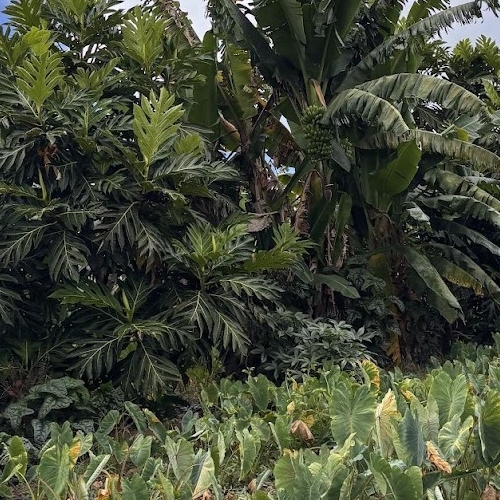
Mixed-crop agroforestry systems like this one, consisting of ʻulu, banana, and kalo, can be very productive. But their financial viability in the modern economy is still murky.
To find out, researchers at the University of Hawaiʻi at Mānoa’s Indigenous Cropping Systems Laboratory and Department of Tropical Plant and Soil Sciences partnered with the Hawaiʻi ʻUlu Cooperative to conduct detailed economic case studies of eight working farms across the state. Each farm had some form of ʻulu agroforestry in place, ranging from a 37-tree ʻulu-banana intercrop on Hawaiʻi Island to a 300-tree silvopasture system on Maui. The result is a picture of what ʻulu agroforestry actually looks like financially in the long term.
Disclaimer:
These case studies are representative of individual systems within wider farms. Many of the farms profiled here have other production zones that do not classify as agroforestry. Thus, these are enterprise budgets that act as a feasibility study for snapshots of smaller systems, rather than entire farms. This means certain farm-wide costs such as land rent, mortgages, major equipment costs like tractors, and major electric or irrigation infrastructure are not modeled.
What the numbers show
Across the eight farms, the average time to break even was 7.75 years from the start of the agroforestry system. Trees take commitment, but they can pay for themselves once mature. The farms that are past that point are generating meaningful returns: average net income across all eight systems is $9,455 per acre per year, with five of the eight farms exceeding $10,000/acre/year.
Average monthly labor runs about 24 hours per acre, which is manageable at small scale, but larger farms tended to see lower per-acre time commitments due to economies of scale.
Here’s how the eight farms compare side by side:
| Farm | System | Break-even | Net income/acre/yr | IRR |
|---|---|---|---|---|
| Kualoa Ranch | Windbreak | 5 yrs | $11,445 | 53.1% |
| Mapele Fields | Endrows | 9 yrs | $13,306 | 24.5% |
| Hāna Ranch | Silvopasture | 10 yrs | $2,666 | 28.4% |
| Māla Kaluʻulu | Multi-story | 18 yrs | $1,956 | 9.46% |
| Big Web Farm | Multi-story | 1 yr | $11,565 | 584.2%* |
| Kahakai Farm | Multi-story + Interplanting | 8 yrs | $11,749 | 24.7% |
| Mahiʻai Made | Alley Cropping + Windbreak | 10 yrs | $5,899 | 35.6% |
| O.K. Farms | Multi-story + Interplanting | 1 yr | $17,042 | 122.5%** |
* Pre-existing mature macadamia trees generated immediate revenue.
** Kalo short-cycle crops covered costs within the first year.
IRR, or internal rate of return, expresses the compounded annual return on the investment over the 30-year projection period. Given the risks and unpredictability of farming, numbers above roughly 20% generally indicate a system worth pursuing. Several of these farms clear that bar by a wide margin.
What the strongest systems have in common
The farms generating the best returns aren’t necessarily the largest or most complex. What they share is a set of strategic choices that show up consistently across the case studies.
1. A dominant revenue driver
ʻUlu is a powerful crop, but the highest-performing farms in this study don’t ask it to carry the whole system. Macadamia nuts drive Big Web Farm’s returns. Kalo accounts for 57% of O.K. Farms’ revenue. Cacao is the foundation at both Mapele Fields and Mahiʻai Made. In each case, ʻulu acts as an enhancer by adding revenue, reducing costs, and improving the ecological health of a system that’s already financially grounded.
The implication for farmers considering ʻulu agroforestry: think about what your dominant revenue crop will be first, then build ʻulu in around it.
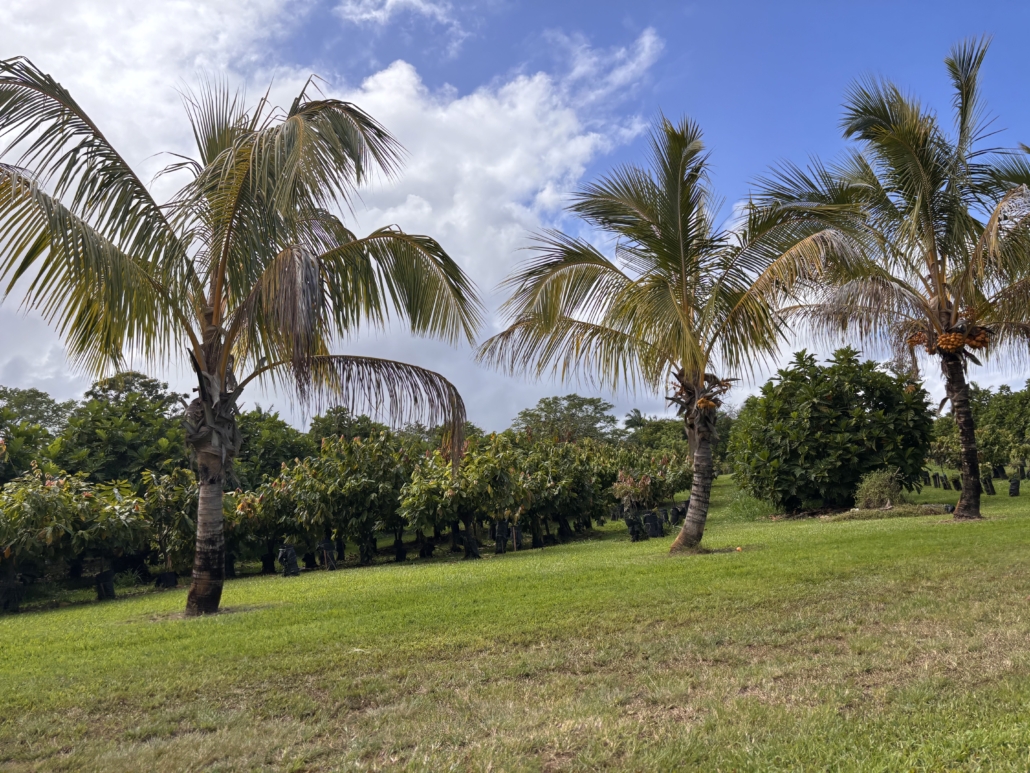
Rows of cacao trees between larger lines of ‘ulu at Mahi’ai Made, coconut in the foreground
2. Short-term bridge crops
ʻUlu trees take several years to reach peak productivity, which is a timeline that can create a financial gap that’s difficult to sustain. The farms that navigated this most successfully did so by intentionally planting shorter-cycle crops alongside the ʻulu from the start.
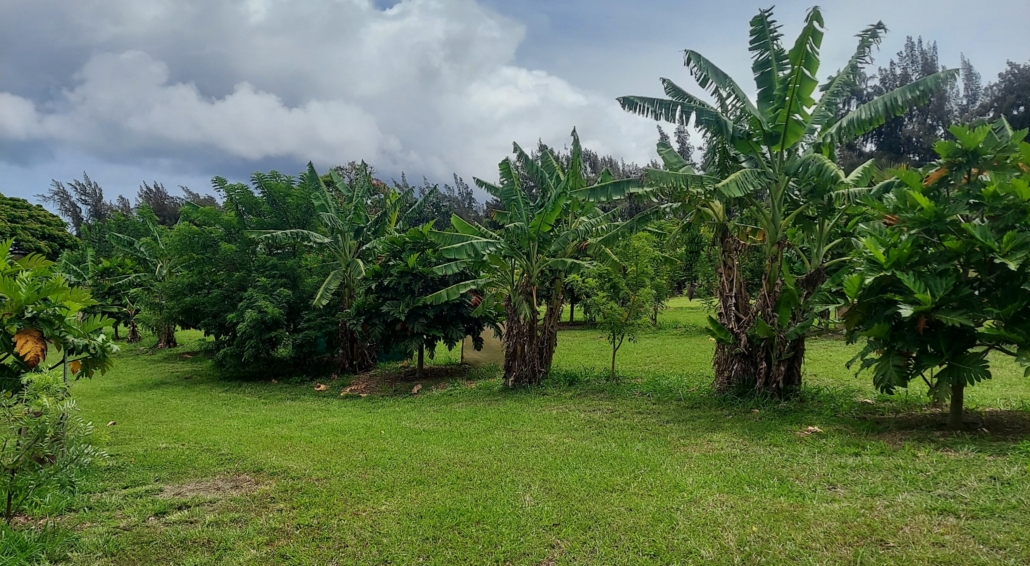
Bananas interplanted between ‘ulu trees at Kahakai Farm
At Kahakai Farm, bananas planted between the ʻulu trees paid the bills during the early years. O.K. Farms’ rotating kalo plots produced harvestable yields on a 9-month cycle. Big Web Farm’s sugarcane juice provided consistent income while the ʻulu grew in. “Stacking” short, medium, and long-term crops in the same acre emerged as the single clearest lesson across all eight farms.
3. Market access
Seven of the eight farms in this study are ʻUlu Co-op members, benefiting from the Cooperative’s guaranteed purchase price, acting as a safety net that makes planting at scale a much more bankable decision. Farms that moved beyond wholesale and into value-added products captured significantly more revenue per unit: finished chocolate, roasted macadamias, pressed sugarcane juice.
If you’re considering planting co-crops with your ʻulu, securing a buyer before you plant is more important than most people realize. High yields with no market are an operational stressor, not a revenue stream.
4. Labor strategy
Labor is the single largest operating cost on nearly every farm in this study, and Hawaiʻi’s farm labor market (among the highest-cost in the country) makes this especially true here. Each farm handled it differently. Mapele Fields and Māla Kaluʻulu rely primarily on family and member-owner labor to keep costs down. Hāna Ranch uses cattle to replace the cost of mowing the ʻulu orchard, one of silvopasture’s most concrete financial advantages. Volunteer workdays fill in for high-intensity tasks like planting at several operations.
Thinking through your labor model early, who will do the work, at what rate, and how that scales, is as important as any decision about which species to plant.
5. Ecology doing economic work
Over time, agroforestry systems tend to reduce their own operating costs. As canopies close in, mowing frequency drops dramatically. Kahakai Farm reports more than a 50% reduction in mowing time since planting. ʻUlu trees established at several farms now serve as windbreaks for adjacent banana and cacao, eliminating the need for artificial wind protection. Cattle at Hāna Ranch provide a supplementary source of fertilzier via their manure, reducing input costs. Heavy mulching with on-farm biomass improves soil moisture and reduces irrigation costs. Several farmers observed better pest and disease resilience in their diversified systems compared to neighboring monocultures. These aren’t soft, intangible benefits, they directly benefit these farmsʻ bottom lines.
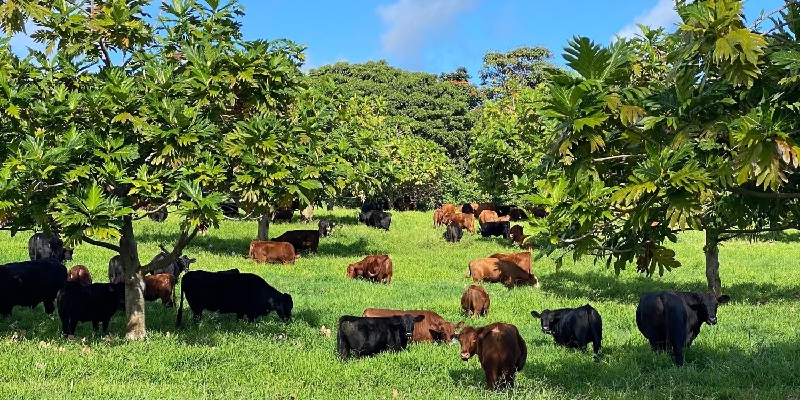
Cattle at Hana Ranch providing their mowing and fertilizer services to nearby ʻulu trees.
Common challenges to plan for
The same data that shows what works also shows where farms struggle. The inverses of common successful characteristics create a few patterns worth knowing:
- Overreliance on tree crops alone creates a multi-year financial gap that can be difficult to sustain without secondary income. This was the primary reason Māla Kaluʻulu’s break-even timeline extended to 18 years.
- Inconsistent secondary markets can undermine projections even when yields are good. Secure buyers before planting crops you plan to sell.
- Harvest intensity is a recurring stressor. ʻUlu’s seasonal production and short shelf life mean labor shortfalls during peak harvest directly reduce revenue. To keep labor demand consistent, plan your co-crop plantings for harvests during the ʻulu off-season in summer.
- High upfront installation costs from irrigation, fencing, and caging young trees are a real barrier. Several farms in this study relied on grants to cover initial investments.
The bottom line
The core pattern across these eight farms is straightforward: the strongest systems use ʻulu agroforestry as a diversification layer on top of an existing or well-planned enterprise. They don’t ask ʻulu alone to generate income from the start. They plan for the gap. They secure markets before they scale. And they let ecology do economic work over time.
As one farmer put it after 50 years of working the land: “This would be my culmination of how to farm.”
This research was conducted by Ryan Weiskopf and Ivy Wappler under Dr. Noa Lincoln at the University of Hawaiʻi at Mānoa, in partnership with the Hawaiʻi ʻUlu Cooperative, supported by Western SARE. A full version of the guide with detailed farm profiles, financial projections, and a resource toolbox is available on the ICS Lab publications page, or at a directly viewable link here.


