Farm-Friendly Bills in the 2026 Legislature
2026 Legislative Session Wrap-Up: Building the Foundation for Tomorrow
The 2026 Hawaiʻi Legislative Session has officially come to a close. Mahalo to your incredible advocacy, written testimony, and dedication to our agricultural communities. While several of our key tracked measures were ultimately deferred or stalled before crossing the final finish line, the deep momentum we built around our core pillars has laid an undeniable foundation for the future:
1. Cooperative Modernization & Development
Our efforts to build a more affordable, modern foundation for community-rooted, grower-owned enterprises gained massive traction this year, clarifying our exact legal roadmap for 2027.
-
SB2922 / HB2404 (General Cooperative Associations Act): This foundational measure aimed to modernize Hawaiʻi’s outdated, sector-specific co-op laws to make forming a cooperative easier and less costly.
-
SB2716 (Cooperative Development Program): This bill sought to establish a dedicated state program to actively support, fund, and train new agricultural and community cooperatives.
2. Farm Viability, Food Security & Infrastructure
Advocating for institutional local sourcing and robust safety nets faced tight fiscal scrutiny, but it successfully cemented regional food systems as a non-negotiable priority for lawmakers.
-
HB2208 (Farms to Families Program): A high-priority initiative designed to fund farm-to-food-bank distribution, connecting local growers directly with families experiencing food insecurity.
-
SB3063 (DOE Procurement): This measure pushed to strengthen local sourcing mandates and streamline procurement pathways for the Department of Education to get more local food into public schools.
-
SB2718 SD1 (Food Hub Pilot Program): This bill aimed to fund and scale regional food hubs, which are critical for the aggregation, storage, and distribution logistics of small-scale farms.
-
SB3162 (Hawaiʻi Strategic Food Reserves Program): A forward-thinking measure to establish a statewide emergency food reserve utilizing locally produced crops to boost disaster resilience.
3. Invasive Species Defense & Climate Adaptation
Biosecurity was a dominant theme this session. We maintained immense pressure on state agencies to speed up funding deployment and emergency response protocols for critical ecological threats.
-
-
HB2139 (Queensland Longhorned Beetle Control): This vital bill sought emergency funding and coordinated management strategies to halt the spread of QLB destroying local agroforestry and groves.
-
SB2885 (Coconut Rhinoceros Beetle Management): Targeted at expanding mitigation, detection, and eradication programs for CRB across the islands.
-
SB2110 (Hawaiʻi Climate Change Mitigation & Adaptation Commission): Aimed to structurally support and fund the state commission tasked with preparing our agricultural sectors for extreme weather and climate impacts.
-
Moving Forward into 2027: Although these specific bills did not become law this session, the vital trial data, community networks, and policy frameworks established over the last few months will serve as our exact blueprint as we prepare to reintroduce these concepts next year. We truly appreciate your efforts and any work that you contributed alongside us!

Policy plays an important role in shaping our food systems and you can help shape Hawaiʻi’s current policy by using your voice. Even a one-sentence testimony counts and shows your commitment to the issues that are important to you.
Read this blog to learn more about how to get involved, what priority bills the ʻUlu Co-op is supporting this year, and to find sample testimony that makes testifying easy! Questions? Reach out to admin@eatbreadfruit.com, we’re here to help!
Bills That HUC is Currently Tracking:
- SB2922/HB2404: Relating to Cooperative Associations (General Cooperative Associations Act) BILL HAS BEEN DEFERRED
- SB2716: Relating to Cooperatives (Cooperative Development Program) BILL HAS BEEN DEFERRED
- SB2718 SD1: Food Hub Pilot Program BILL HAS BEEN DEFERRED
- SB3063: Relating to Department of Education Procurement BILL HAS BEEN DEFERRED
- HB2208: Relating to Food Security (Farms to Families) BILL HAS BEEN DEFERRED
- HB2139: Relating to Invasive Species (Queensland Longhorn Beetle) BILL HAS BEEN DEFERRED
- SB2885: Coconut Rhinoceros Beetle Management BILL HAS BEEN DEFERRED
- SB2110: Hawaiʻi Climate Change Mitigation and Adaption Commission BILL HAS BEEN DEFERRED
- SB3162: Hawaiʻi Strategic Food Reserves Program BILL HAS BEEN DEFERRED
Scroll down for more details of each bill, why we are prioritising them, how to support them, and to see sample testimony for each.
Basic guide to submitting testimony in under 5 minutes:
- Create an Account at on the capitol website – Register Here.
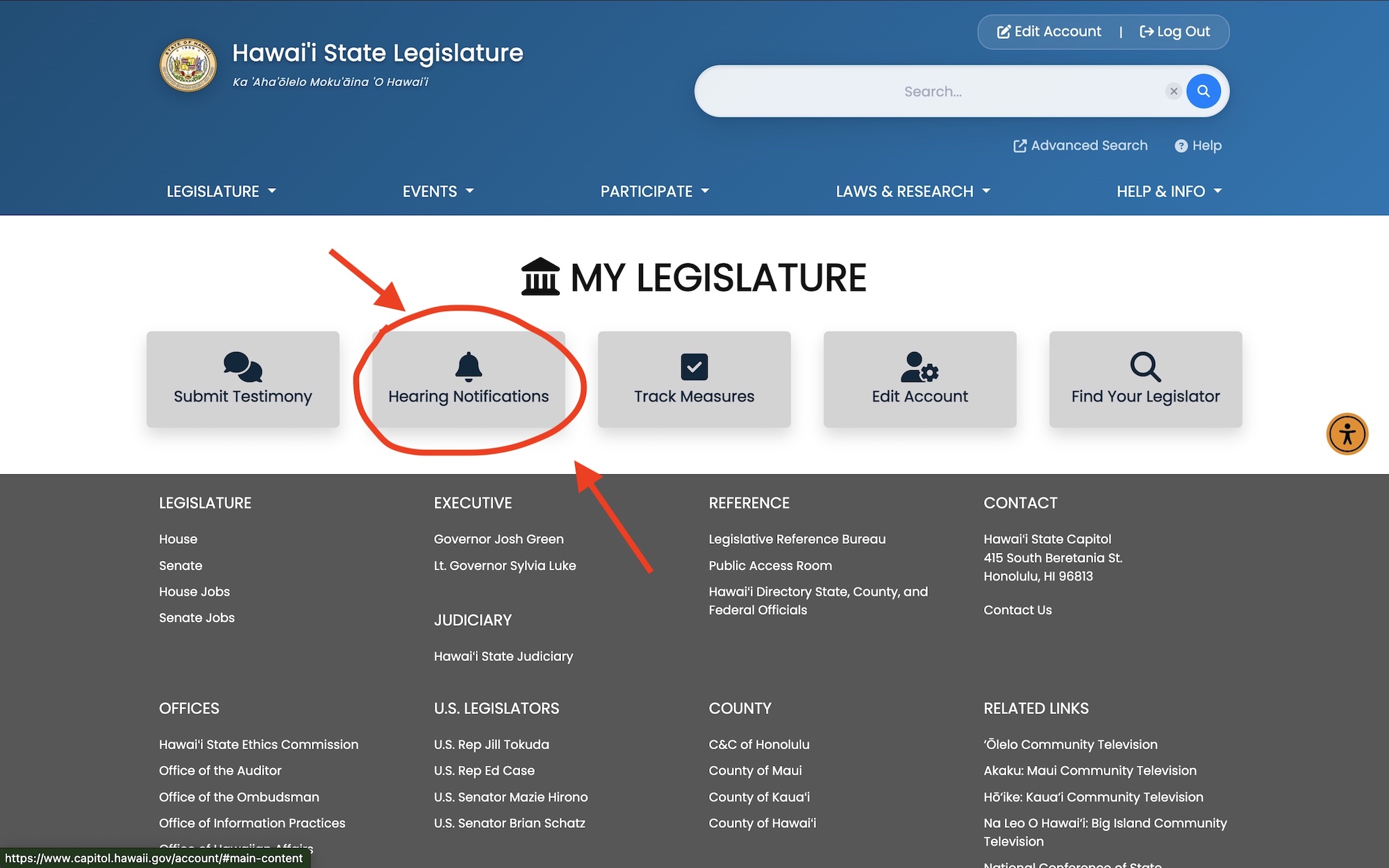
- Sign up for Hearing Notices. Hearings are announced at minimum 72 hours before they take place; getting notifications straight to your email ensures you don’t miss a single one. See highlighted circle on screenshot of capitol site homepage below for where to sign up.
- Submit Written Testimony at least 24 hours before the hearing to be on time. (Late testimony can be submitted but will be stamped “late”).
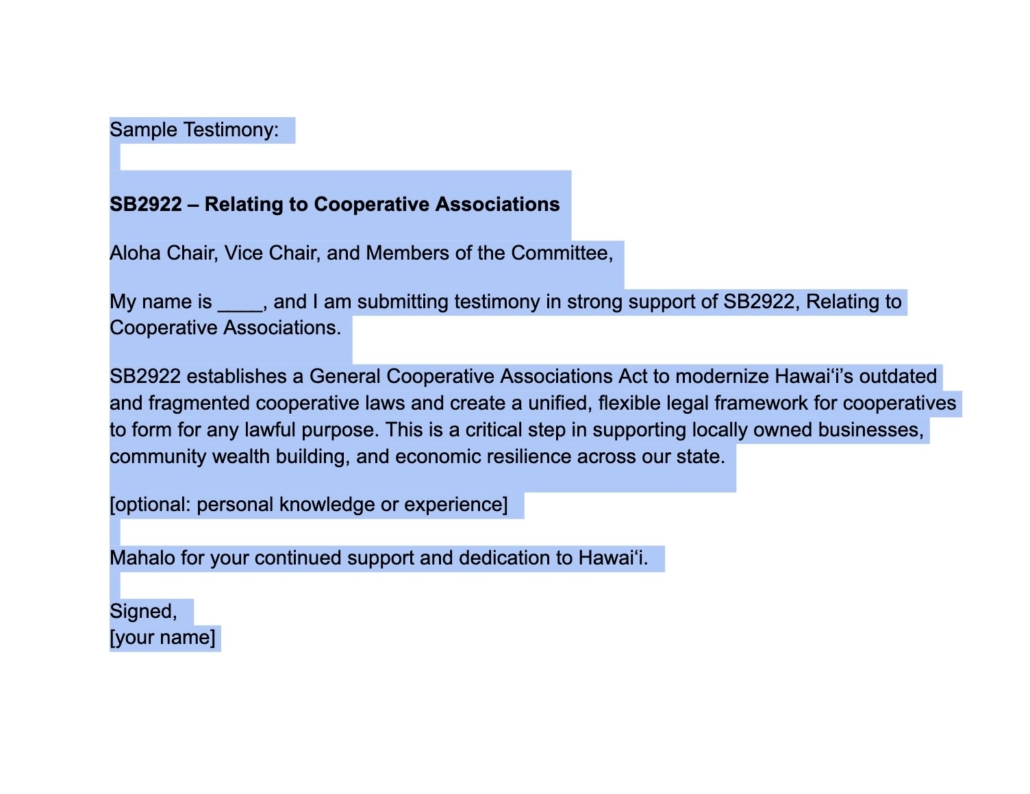
- Copy sample testimony (scroll down for full list of sample testimonies)
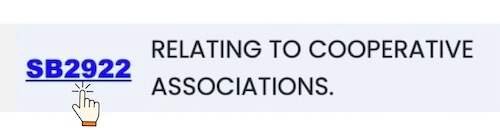
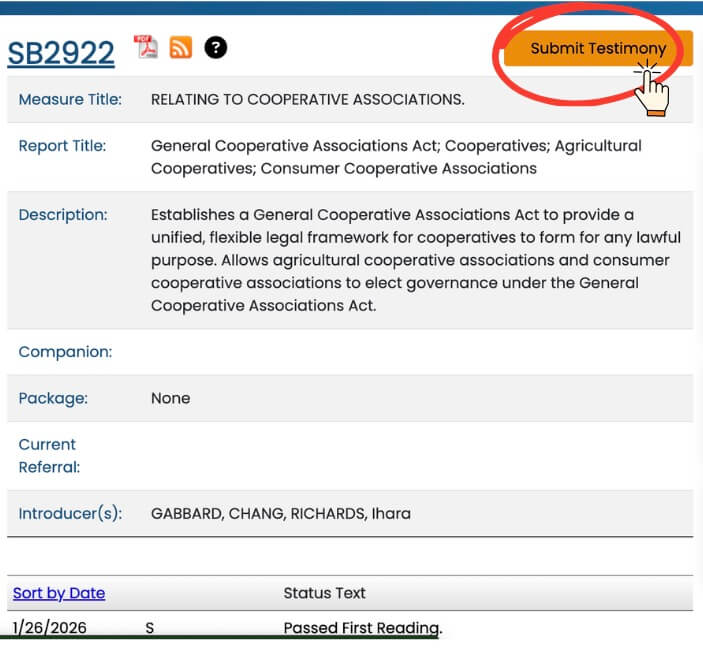
Click the hyperlinked bill number to go to capitol website
Click “Submit Testimony”
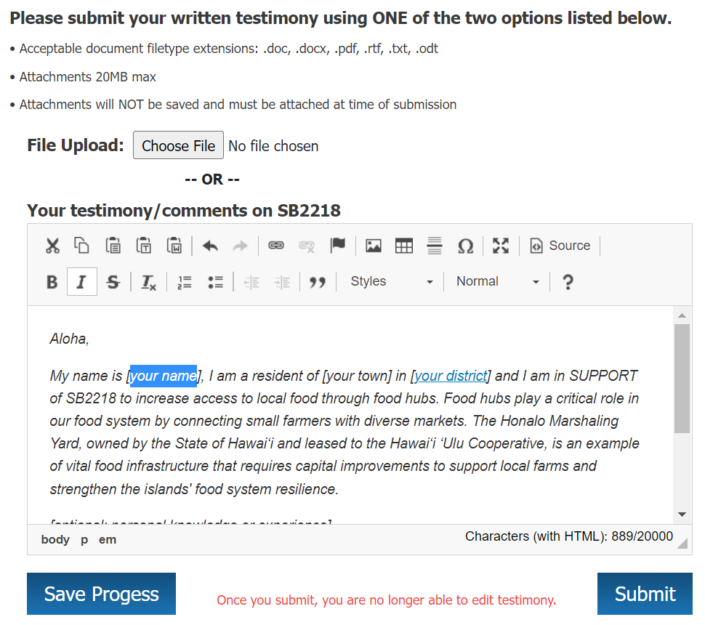
Fill in your information and paste your testimony comments.
(Optional) Submit Oral Testimony during the hearing, up to 2 minutes in length.
HUC’s 2026 Priority Bills:
SB2922 / HB2404: General Cooperative Associations Act
LEGISLATIVE UPDATE 4/15:
Latest Action: As of April 15th, 2026, SB2922 has officially missed the Second Decking deadline. There has been no movement on the bill since it was referred to the House Committee on Consumer Protection & Commerce (CPC) on March 12th. Because the committee did not schedule a hearing or file a standing committee report by the April 10th cutoff, the bill is now considered “dead” for this legislative session.
What this means: Since the bill failed to advance out of its final House committee by the mandatory deadline, it cannot proceed to a final Third Reading or a floor vote. While the measure successfully passed the Senate and reached the House, it has stalled in the committee process. This means the current laws regarding Cooperative Associations will remain unchanged for now, though the strong support seen earlier this session—including its unanimous passage in the Senate—suggests a high likelihood for the bill to be reintroduced or used as a foundation for next year’s session.
LEGISLATIVE UPDATE 4/6:
Latest Action: As of April 6th, 2026, there has been no further movement on SB2922 since the update last week. The bill’s status remains exactly where it was on March 12: Referred to the House Committee on Consumer Protection & Commerce (CPC).
What this means: While it feels like a long time without news, this “quiet period” is common in the Hawaii Legislature after a bill crosses over to the second chamber. However, the clock is ticking: the Second Decking deadline is April 10th. This means the House CPC committee must hear, pass, and file the bill by this Friday for it to remain “alive” and move toward a final House vote. If it is not scheduled for a hearing or passed by the end of this week, the bill may stall for the remainder of the session.
LEGISLATIVE UPDATE 3/30:
As of March 30th, 2026, there has been no further movement on SB2922 since the update last week. The bill’s status remains exactly where it was on March 12: Referred to the House Committee on Consumer Protection & Commerce (CPC).
LEGISLATIVE UPDATE 3/23:
As of March 23rd, 2026, there has been no further movement on SB2922 since the update last week.
The bill’s status remains exactly where it was on March 12: Referred to the House Committee on Consumer Protection & Commerce (CPC).
LEGISLATIVE UPDATE 3/16:
Latest Action: On March 12, 2026, the bill was officially referred to the House Committee on Consumer Protection & Commerce (CPC) as Referral Sheet 17. This follows the bill’s successful Third Reading and “Crossover” from the Senate on March 10, 2026.
What this means: The bill has moved into the second half of its journey. Having passed the full Senate unanimously, it is now under the jurisdiction of the House. The CPC committee will be the first House body to review the measure.
LEGISLATIVE UPDATE 3/9:
Latest Action: On March 3, 2026, the Senate Committee on Judiciary (JDC) recommended that the measure be passed with amendments. The committee vote was unanimous with 5 Ayes and 0 Noes.
What this means: The bill has passed another major test in the Senate. Because the Judiciary committee voted “yes,” the bill—now updated as Senate Draft 1—will move to the entire Senate for a final vote on 3/10. If it passes there, it will move over to the House of Representatives to begin the next stage of the process.
LEGISLATIVE UPDATE 3/2:
Latest Action: On February 24, 2026, the Senate Committee on Judiciary (JDC) scheduled a public decision-making hearing for March 3, 2026, at 10:15 AM (Conference Room 016 & Videoconference).
What this means: The bill has passed its initial committee (Commerce and Consumer Protection) and is now being reviewed by the Judiciary committee; this next meeting is where committee members will vote on whether to pass the bill (likely with amendments) to the full Senate for a final vote.
Previous Status (February 20, 2026): As of February 20, 2026, SB 2922 is successfully moving through the Senate. Following its public hearing on February 18, the Committee on Commerce and Consumer Protection (CPN) recommended that the bill pass Second Reading with amendments (SD1). It has now been referred to the Committee on Judiciary (JDC) for further consideration.
Continued Info:
SB2922 and its companion HB2404 establish a new General Cooperative Associations Act in the Hawaiʻi Revised Statutes to modernize and unify Hawaiʻi’s fragmented cooperative laws. The Act creates a flexible legal framework allowing cooperatives to form for any lawful purpose while preserving core cooperative principles such as democratic member control, patronage-based distributions, and community benefit. Existing agricultural and consumer cooperative associations may elect to operate under this new framework, providing greater flexibility and clearer governance options than current sector-specific statutes.
Key Points
-
Establishes a unified cooperative statute with consistent rules for formation, governance, member rights, fiduciary duties, distributions, and dissolution.
-
Enables worker-owned, multi-stakeholder, service, and platform cooperatives to legally organize as cooperatives in Hawaiʻi.
-
Preserves democratic governance through one-member, one-vote control.
-
Allows multiple classes of members, including workers, producers, consumers, and community stakeholders.
-
Supports patronage-based profit sharing and cooperative capital structures.
-
Allows existing agricultural and consumer cooperatives to opt into the new framework.
Why This Matters
Hawaiʻi’s current cooperative laws are outdated and fragmented across narrow, sector-specific statutes that increase legal complexity and limit innovation. SB2922 and HB2404 modernize and simplify the legal foundation for cooperatives, making it easier and more affordable to form community-owned enterprises while supporting business succession, job quality, and local wealth building. The bill strengthens cooperative development across agriculture, worker ownership, housing, renewable energy, consumer retail, and other community-rooted sectors, helping keep wealth circulating within Hawaiʻi.
One Liner
SB2922 / HB2404 modernizes Hawaiʻi’s outdated cooperative laws by creating a unified, flexible legal framework that enables multi-stakeholder, worker-owned, and community-owned businesses to form across any industry with more innovative membership structures.
Sample Testimony
Aloha Chair, Vice Chair, and Members of the Committee,
My name is ____, and I am submitting testimony in strong support of SB2922 / HB2404, Relating to Cooperative Associations.
This legislation establishes a General Cooperative Associations Act to modernize Hawaiʻi’s outdated and fragmented cooperative laws and create a unified, flexible legal framework for cooperatives to form for any lawful purpose. This is a critical step in supporting locally owned businesses, community wealth building, and economic resilience across our state.
Currently, Hawaiʻi relies on multiple narrow, sector-specific cooperative statutes that increase legal complexity, raise startup costs, and limit innovation. Entrepreneurs and community members who wish to form worker-owned, multi-stakeholder, or community-based cooperatives often face unnecessary legal hurdles or are forced into corporate structures that do not reflect cooperative values or democratic governance.
By creating a single, modern cooperative statute, SB2922 / HB2404 will:
-
Make it easier and more affordable to form cooperatives.
-
Provide clear and consistent governance rules.
-
Support locally owned businesses across agriculture, housing, energy, retail, technology, and other sectors.
-
Allow existing agricultural and consumer cooperatives to opt into a more flexible framework if they choose.
Cooperatives are proven to create stable jobs, keep wealth circulating locally, and strengthen rural and community economies. Across the country, states with modern cooperative laws have seen growth in worker ownership, small business succession through cooperative conversions, and increased community investment.
This bill positions Hawaiʻi to join those states by providing the legal infrastructure needed for cooperative enterprises to thrive. At a time when many local businesses struggle with rising costs, workforce challenges, and ownership transitions, cooperatives offer a practical, locally rooted solution that benefits workers, consumers, and communities alike.
I respectfully urge the committee to pass SB2922 / HB2404 and help modernize Hawaiʻi’s cooperative laws to better support local ownership and economic opportunity.
Mahalo for the opportunity to testify,
(your name).
SB2716: Cooperative Development Program
LEGISLATIVE UPDATE: Status Update (February 19, 2026): Please be advised that SB 2716 was officially deferred by the Senate Committee on Economic Development and Technology (EDT) during its hearing on February 19, 2026.
What This Means: While the bill received strong testimony from the Hawaiʻi ʻUlu Producers Cooperative and other community stakeholders, the committee has chosen to postpone further action indefinitely. In the current legislative cycle, a deferral at this stage usually means the measure will not meet the necessary deadlines to move to the next committee (Ways and Means) or cross over to the House.
Next Steps for Advocates:
-
Analyze the Concerns: We will be reviewing the committee’s discussion to understand the specific hurdles—whether budgetary or administrative—that led to the deferral.
-
Refine the Proposal: This “pause” provides an opportunity to work closely with the Department of Business, Economic Development, and Tourism (DBEDT) and legislative leaders to refine the program structure for future introduction.
-
Continued Support: Although SB 2716 is not moving forward this session, the momentum built for cooperative development remains strong. We thank everyone who submitted testimony and shared their stories.
Continued Info:
SB2716 establishes a Cooperative Development Program within the Department of Business, Economic Development, and Tourism (DBEDT) to support the creation and expansion of cooperatives across Hawaiʻi. The program provides cost-share grants to help cover administrative startup and conversion costs, as well as grants to nonprofit cooperative development partners that deliver technical assistance, training, and outreach. The bill prioritizes projects that increase worker and community ownership, retain or create quality jobs, strengthen rural and agricultural economies, and support underserved communities, including Native Hawaiian communities.
Key Points
- Creates a statewide Cooperative Development Program housed at DBEDT
- Provides cost-share grants of $10,000 to $50,000 to help cooperatives cover startup and conversion costs such as legal services, feasibility studies, business planning, and governance development
- Requires a 25% match, which may include cash, other grants, or in-kind contributions like volunteer labor or donated professional services
- Funds nonprofit cooperative development partners to provide technical assistance, education, training, and outreach
- Prioritizes worker ownership, job creation and retention, rural and agricultural communities, Native Hawaiian, and underserved populations
- Includes reporting, evaluation, and program oversight to track outcomes and effectiveness
- Appropriates $750,000 for program implementation for FY 2026–2027, with a sunset date of June 30, 2031
Why This Matters
Starting or converting a business to cooperative ownership often requires significant upfront costs that are out of reach for workers, farmers, and community members, even when cooperative ownership would preserve jobs and strengthen local economies. SB2716 removes this barrier by investing directly in cooperative formation and development.
By pairing financial support with technical assistance, the bill helps grow worker-owned and community-owned businesses, supports business succession, improves job quality, strengthens rural and agricultural economies, and keeps wealth circulating locally. Together with SB2922’s modern legal framework, SB2716 provides the practical resources needed to build a thriving cooperative ecosystem in Hawaiʻi.
One Liner
SB2716 creates a Cooperative Development Program at DBEDT to provide grants and technical assistance that help start and convert cooperatives, prioritize worker ownership, quality jobs, and community economic resilience.
Sample Testimony
Aloha Chair, Vice Chair, and Members of the Committee,
My name is _____, and I am submitting testimony in strong support of SB2716, which establishes a Cooperative Development Program within the Department of Business, Economic Development, and Tourism.
SB2716 addresses one of the biggest barriers to cooperative formation and conversion in Hawaiʻi: the high upfront administrative costs required to organize a cooperative or transition an existing business to worker or community ownership. Feasibility studies, legal services, business planning, and governance development often cost tens of thousands of dollars, placing cooperative ownership out of reach for many workers, farmers, and community members.
This bill creates a practical solution by providing cost-share grants and funding nonprofit cooperative development partners to deliver technical assistance, education, and outreach. It prioritizes worker ownership, job retention and creation, rural and agricultural communities, and underserved populations, including Native Hawaiian communities.
Furthermore, I respectfully request that the bill be amended to explicitly include funding and technical assistance for the development of established cooperatives. While startup support is vital, providing resources for existing cooperatives to scale their operations, modernize governance, and reinvest in their communities ensures long-term economic resilience.
Across the country, similar programs have successfully supported cooperative enterprises that create quality jobs, strengthen local economies, and keep businesses rooted in their communities. SB2716 brings this proven approach to Hawaiʻi.
Together with SB2922’s modern cooperative legal framework, SB2716 builds the financial and institutional infrastructure needed for cooperatives to thrive.
I respectfully urge the committee to pass SB2716 and invest in locally owned businesses that strengthen Hawaiʻi’s economy and communities.
Mahalo for the opportunity to testify,
(your name).
SB2718 SD1: Food Hub Pilot Program
LEGISLATIVE UPDATE 4/15:
Latest Action: As of April 15th, 2026, SB2718 has officially missed the Second Decking deadline. There has been no movement on the bill since it passed its Second Reading and was referred to the Senate Committee on Ways and Means (WAM) on February 20th. Because the committee did not schedule a hearing or move the bill forward to a final floor vote by the April 10th cutoff, the measure is now considered “dead” for this legislative session.
What this means: This bill aimed to appropriate vital funds for the continuation of the Food Hub Pilot Program, which has been essential for connecting local farmers—including those producing ʻulu—to schools and institutions. Despite passing through the Agriculture and Environment (AEN) and Government Operations (GVO) committees with strong support, the failure to clear the Ways and Means committee by the deadline means no new state funding will be allocated through this specific bill this year. While the pilot program itself continues under its original mandate, advocates will need to look toward the 2027 session to secure long-term funding or explore alternative administrative budget adjustments.
LEGISLATIVE UPDATE 4/6:
As of April 6th, 2026, there has been no further movement on SB2718 since the update on March 20th. The bill’s status remains: Reported from the House Committee on Agriculture & Food Systems (AGR) with recommendation to pass with amendments, and referred to the House Committee on Finance (FIN).
LEGISLATIVE UPDATE 3/30:
As of March 30th, 2026, there has been no further movement on SB2718 since the update last week.
The bill’s status remains exactly where it was on March 12: Referred to the House Committee on Agriculture & Food Systems (AGR) and the House Committee on Finance (FIN).
LEGISLATIVE UPDATE 3/23:
Latest Action: On March 12, 2026, the bill was officially referred to the House Committee on Agriculture & Food Systems (AGR) and the Committee on Finance (FIN) as part of Referral Sheet 17.
What this means: The bill has successfully entered the House side of the legislature. Its first stop will be the AGR committee, which will review the merits of continuing the Food Hub Pilot Program. If they approve it, the bill will then move to the Finance committee (FIN) to finalise the specific dollar amount for the appropriation.
LEGISLATIVE UPDATE 3/16:
Latest Action: Following its referral to the Ways and Means (WAM) committee on February 20, the bill was pulled for a final Senate floor vote. It passed Third Reading on March 10, 2026, and was formally transmitted to the House on March 11.
What this means: The bill is no longer in the Senate. The “February 20” date you see on the tracking page represents the last committee action, but the March 10 floor vote is the move that sent it to the House. It is currently in the “Crossover” phase, awaiting its first House committee assignment.
LEGISLATIVE UPDATE 3/9:
There has been no change since our last update. The bill is still alive, but awaiting ways and Means committee approval.
LEGISLATIVE UPDATE 3/2:
Latest Action: On February 20, 2026, the bill passed its Second Reading and was referred to the Senate Committee on Ways and Means (WAM).
What this means: The bill has successfully moved past the joint policy committees (Agriculture & Environment and Government Operations) and is now in the “money committee.” Because the bill involves funding for the Food Hub Pilot Program, the Ways and Means committee must now review and approve the financial costs before it can move to a final vote in the Senate.
What This Bill Does (Updated Version SD1)
The amended version of the bill (SD1) strengthens the push for Hawaiʻi’s food self-sufficiency by focusing on both infrastructure and institutional procurement:
-
Infrastructure Grants: Appropriates $5 million for the continued implementation of the Food Hub Pilot Program, providing “bricks and mortar” funding for cold storage, trucks, and processing equipment.
-
30% Local Food Mandate: By January 1, 2028, it requires state departments (including Education, Health, Corrections, Defense, and the University of Hawaiʻi) to ensure that at least 30% of their produce purchases are fresh local agricultural products or local value-added items.
-
Educational Integration: Tasks the Department of Agriculture and Biosecurity (DAB) with developing a land-based (“āina-based”) nutrition program for public schools.
-
Support for Native Hawaiian Crops: Requires partnerships with regional aggregators to specifically support the processing and distribution of traditional staple crops like ʻulu and kalo.
Why This Matters Now
With the inclusion of the 30% local food mandate, SB 2718 is no longer just about building food hubs—it is about guaranteeing a market for them. This creates a stable demand cycle of:
-
Supply: Farmers grow more crops knowing a food hub can process them.
-
Infrastructure: SB 2718 grants help hubs buy the equipment to handle that supply.
-
Demand: State institutions are mandated to buy that processed food for schools and hospitals.
Next Steps for Advocates
The referral to Ways and Means (WAM) is the “make or break” moment for this bill, as the committee will decide if the $5 million appropriation fits within the state’s budget.
-
Prepare Testimony for WAM: Focus on the Return on Investment (ROI). Highlight how every dollar spent on food hub infrastructure translates into local jobs and reduced dependency on expensive imports.
-
Reference the Success of the Pilot: Mention the Department of Agriculture’s 2025 report which showed that previous food hub grants successfully helped hubs like Adaptations, Inc. reach over $2.5 million in annual sales while supporting hundreds of small farms.
Continued Info:
SB2718 establishes a five-year Food Hub Pilot Program within the Department of Agriculture to provide grant funding to Hawaii-based food hubs. The program is designed to support the scaling of food hub operations, including the purchase of equipment, facility improvements, and technical assistance. By providing consistent funding, the bill aims to increase the capacity of food hubs to aggregate, process, and distribute locally grown food to institutional markets, such as schools and hospitals, thereby strengthening Hawaii’s food security and supporting local farmers.
Key Points
-
Establishes a 5-Year Pilot: Creates a formal Food Hub Pilot Program under the Department of Agriculture (DOA).
-
Grant Funding: Provides financial assistance for “bricks and mortar” needs, including equipment purchases (cold storage, trucks) and facility upgrades.
-
Technical Assistance: Includes funding for business development, food safety certification (GAP/FSMA), and operational training.
-
Focus on Scaling: Specifically targets the expansion of existing food hubs to help them meet the high volume demands of state institutions.
-
Reporting & Data: Requires the DOA to submit an annual report to the Legislature to track the program’s impact on local food production and distribution.
-
Appropriation: Appropriates a yet-to-be-determined amount for FY 2026–2027 to jumpstart the program.
Why This Matters
Food hubs are the “missing middle” of Hawaii’s agricultural infrastructure. While individual small farms often struggle to reach large markets, food hubs provide the necessary aggregation and professional processing to move local food into the mainstream. However, the high cost of industrial equipment and food safety compliance often prevents these hubs from scaling. SB2718 removes these financial bottlenecks, allowing food hubs to become the backbone of a resilient, self-sufficient local food system.
One Liner
SB2718 establishes a five-year pilot program to provide grants and technical assistance to Hawaii food hubs, enabling them to scale operations and increase the distribution of locally grown food across the islands.
Sample Testimony
Aloha Chair, Vice Chair, and Members of the Committee,
My name is [Your Name], and I am submitting testimony in strong support of SB2718, which establishes a five-year Food Hub Pilot Program and grant funding within the Department of Agriculture.
As a [farmer/consumer/food hub member], I have seen firsthand that the greatest challenge to Hawaii’s food self-sufficiency isn’t just growing the food—it’s the infrastructure required to move that food from the field to the table. Food hubs serve as the essential link, providing small and mid-sized farmers with the aggregation, cold storage, and distribution networks they need to reach institutional buyers like the Department of Education.
SB2718 addresses the primary barrier to food hub success: the high capital cost of scaling. By providing grants for equipment, facility improvements, and technical assistance, this bill allows our local food hubs to professionalize and expand. This investment ensures that our farmers have a reliable marketplace and that our communities have consistent access to fresh, locally grown produce.
Furthermore, I believe that supporting food hubs is one of the most efficient uses of state agricultural funding. A single grant to a food hub supports dozens, if not hundreds, of individual family farms simultaneously. This “multiplier effect” strengthens our rural economies and keeps food dollars circulating within our islands.
Across the country, states that invest in food hub infrastructure see a direct increase in agricultural productivity and food security. SB2718 is a critical step toward making Hawaii’s food system more resilient and less dependent on overseas imports.
I respectfully urge the committee to pass SB2718 and invest in the vital infrastructure that will feed Hawaii’s future.
Mahalo for the opportunity to testify,
(your name).
SB3063 – Relating To Department Of Education Procurement
LEGISLATIVE UPDATE 5/12:
Latest Action: As of May 1st, 2026, SB3063 was the subject of intense negotiations, with the Conference Committee reconvening three times in a single day (1:30 PM, 4:00 PM, and 5:00 PM). While the bill reached the final stage of the legislative process, it failed to reach a final agreement (CD1) before the mandatory adjournment. Despite the late night efforts in Conference Room 229, the House and Senate versions could not be reconciled, and the measure did not move to a Final Reading.
What this means: Because a final “Conference Draft” was not approved and voted on by both chambers before the session ended, the bill is now dead. This specific bill would have allowed the DOE to prioritize local edible produce (like ‘ulu!) by exempting certain local purchases from the standard procurement code if they were within 5% of the cost of non-local alternatives.
LEGISLATIVE UPDATE 5/4:
Latest Action: As of May 4th, 2026, SB3063 has moved into the Conference Committee stage. Following the Senate’s disagreement with House amendments on April 10th, lead negotiators from both chambers were appointed to reconcile the different versions of the bill. A conference committee meeting was held on April 28th, 2026, to finalize the language. Because the bill was part of these active negotiations through the final April deadlines, it remains “alive” and on the path toward a final floor vote.
What this means: Unlike measures that stalled in committee, SB3063 has successfully navigated both the Senate and the House and is now in the final stage of the legislative process. The House and Senate are working to agree on the exact wording for the Department of Education procurement reform, which aims to simplify how local schools purchase food. Once the Conference Committee files its final report, the bill will head to a final vote in both chambers before being sent to the Governor’s desk for signature. This is a major step forward for farm-to-school initiatives across the islands.
LEGISLATIVE UPDATE 4/27:
Latest Action: As of April 27th, 2026, SB3063 remains in Conference Committee for active negotiations. While conferees were appointed on April 20th, there have been no further public filings or a “Notice of Conference Committee Meeting” posted since the last update. We are now entering the final “decking” window; the committee must reach an agreement and file a final Conference Committee Report by the April 29th deadline for the bill to move forward to a final floor vote.
What this means: No news is currently “steady news.” The bill is still very much alive, but it is in the most critical high pressure phase of the session. Since this is a non-fiscal procurement bill, the deadline to file the final negotiated version is this Wednesday, April 29th. If the committee members (including Chairs Kim and Woodson) successfully “agree to disagree” and sign off on a final version by Wednesday, the bill will be “decked” for a final reading in both chambers. If they fail to file by that deadline, the bill will essentially “run out of time” for the 2026 session.
LEGISLATIVE UPDATE 4/20:
Latest Action: As of April 20th, 2026, SB3063 has officially moved into the final stage of the legislative process with the appointment of a Conference Committee. Following the Senate’s disagreement with House amendments on April 10th, both chambers have now named their representatives to resolve the bill’s final language. House Conferees include Representatives Woodson and Lee as Co-Chairs, and Representative Souza, while Senate Conferees include Senator Kim as Chair, Senator Kidani as Co-Chair, and Senator DeCorte.
What this means: The bill is “alive” and has reached the home stretch. By appointing conferees, the House and Senate are committing to a final negotiation to align their versions of the bill before the session ends. If a consensus is reached in this committee, the bill will head to a final floor vote and then to the Governor’s desk. This progress is a positive sign for the cooperative’s goal of streamlining Department of Education procurement rules, potentially making it much easier for local producers to provide fresh food to Hawaiʻi’s schools.
LEGISLATIVE UPDATE 4/15:
Latest Action: As of April 15th, 2026, SB3063 has successfully advanced past the Second Decking deadline but has entered a new phase of disagreement. On April 10th, the Senate officially disagreed with the amendments made by the House (HD1). The measure has now been returned to the House, and notice of this disagreement was received on the same day.
What this means: Unlike the previous bills, SB3063 is very much “alive.” Because the House and Senate passed different versions of the bill, it is now headed for Conference Committee. In this stage, a small group of House members and Senators will meet to resolve the differences between the two versions (specifically regarding the Department of Education’s procurement exemptions for local food). They must reach a consensus and file a final version of the bill by the “Final Decking” deadline later this month for it to go to the Governor’s desk. This is a positive sign for local food procurement, as both chambers clearly support the intent of the bill but are still fine-tuning the specific legal language.
LEGISLATIVE UPDATE 4/6:
Latest Action: As of April 6th, 2026, there has been no further movement on SB3063 since the update on March 24th. The bill’s status remains: The House Committee on Education (EDN) recommended that the measure be PASSED, WITH AMENDMENTS.
What this means: The bill has cleared its first hurdle in the House. However, it was referred to two committees: Education (EDN) and Finance (FIN). Because this Friday, April 10th, is the Second Decking deadline, the Finance committee must hear, pass, and file the final version of the bill by the end of this week for it to remain “alive.” If it is not scheduled and passed by FIN by Friday, the bill will fail to move forward this session.
LEGISLATIVE UPDATE 3/30:
Latest Action: On March 24, 2026, the House Committee on Education (EDN) recommended that the measure be PASSED, WITH AMENDMENTS. This follows the bill’s referral to both the EDN and Finance (FIN) committees on March 10 after its successful “Crossover” from the Senate.
What this means: The bill has cleared its first major hurdle in the House. It is now moving through the amendment process and is awaiting its next referral or hearing, typically with the House Committee on Finance (FIN), before it can proceed to a full House vote.
LEGISLATIVE UPDATE 3/23:
Latest Action: On March 20, 2026, SB 3063 was officially scheduled for its first House public hearing before the Committee on Education (EDN).
-
Hearing Date/Time: Tuesday, March 24, 2026, at 2:00 PM
-
Location: House Conference Room 309 & Videoconference
What this means: The bill is back in motion! After a period of inactivity following its crossover from the Senate, the House Education committee has formally placed it on the calendar. This measure—which would allow the DOE to pay a 5% premium for local food—is now facing its first major test in the House. If passed tomorrow, it will proceed to the Finance (FIN) committee.
LEGISLATIVE UPDATE 3/16:
Latest Action: On March 10, 2026, the bill was officially referred to the House Committees on Education (EDN) and Finance (FIN) as part of Referral Sheet 16. This followed the bill’s successful “Crossover” from the Senate, where it passed its Third Reading on March 6, 2026.
What this means: The bill has successfully transitioned to the House of Representatives. It is now awaiting its first House hearing in the Education committee.
LEGISLATIVE UPDATE 3/9:
Latest Action: On March 6, 2026, the bill was received from the Senate in amended form (Senate Draft 1). This follows a unanimous vote by the Senate Committee on Ways and Means (WAM) on March 3, 2026, recommending that the bill pass its final Senate reading.
What this means: The bill has successfully passed all its requirements in the Senate. Because it was approved by the Ways and Means committee and then the full Senate, it has now “crossed over” to the House of Representatives. The House will now begin its own review and voting process to decide if the bill should become law.
LEGISLATIVE UPDATE 3/2:
Latest Action: On February 25, 2026, the Senate Committee on Ways and Means (WAM) held a public decision-making hearing and recommended that the bill be passed as amended (SD 2).
What this means: The bill has cleared its final Senate committee and is moving toward a full Senate vote; because this was a “Decision-Making” session, they were not taking new testimony at that time.
Previous Status (February 24, 2026): As of February 18, 2026, SB 3063 has cleared a major hurdle. It passed its Second Reading with amendments (SD1) and has been referred to the Senate Committee on Ways and Means (WAM).
Next Steps for Advocates
The bill is now in the Ways and Means (WAM) committee. Since this bill involves “price preferences” (which technically cost the state slightly more in the short term), the focus of testimony must be on the long-term savings.
Key points for WAM Testimony:
-
Economic Leakage: Remind the committee that 90% of our food dollars currently leave the state. A 5% “premium” on local food is actually a 95% “discount” on economic leakage.
-
Health Outcomes: Fresh local produce reduces the long-term health costs associated with highly processed school meals.
-
Support for Local Business: This is a direct reinvestment in Hawaiʻi’s small business economy.
Continued Info:
Relating to Department of Education Procurement SB3063 authorizes the Department of Education to expend up to five per cent more for the procurement of local edible produce and local packaged food products than the cost of non-local alternatives. The Act provides a critical exemption for these specific local food purchases from the State’s restrictive electronic procurement system requirements, instead establishing a streamlined “small purchase” process for acquisitions under $250,000. By modernizing school food purchasing rules, the bill aims to reduce administrative barriers that currently prevent local farmers and food producers from supplying Hawaiʻi’s public schools.
Key Points
- Authorizes a 5% price preference for the procurement of local edible produce and packaged food products by the DOE
- Exempts local food purchases under $250,000 from mandatory use of the state electronic procurement system
- Streamlines the bidding process by requiring a minimum of only three quotes for local food contracts, rather than complex formal solicitations
- Reduces administrative “red tape” for small-scale local farmers and vendors seeking to sell to the Department of Education
- Aligns DOE procurement practices with state goals to increase local food production and institutional purchasing
- Requires the department to maintain records of these small purchases to ensure transparency and accountability
Why This Matters
Hawaiʻi’s public schools are among the state’s largest food consumers, yet rigid procurement laws often force the Department of Education to choose the cheapest imported goods over fresh, local alternatives. SB3063 removes the technical hurdles that make it difficult for local producers to navigate the state’s digital bidding systems. By allowing a price preference and simplifying the quote process, the bill makes it economically viable and administratively possible for schools to source food from Hawaiʻi’s own farms. This keeps taxpayer dollars circulating in the local economy, supports food security, and provides students with fresher, more nutritious meals.
One Liner
SB3063 supports Hawaiʻi’s local farmers and improves school meals by allowing the Department of Education to pay a small premium for local food and exempting those purchases from complex electronic bidding requirements to simplify the procurement process.
Sample Testimony
Aloha Chair, Vice Chair, and Members of the Committee,
My name is ____, and I am submitting testimony in strong support of SB3063, Relating to the Department of Education Procurement.
SB3063 authorizes a critical 5% price preference for the procurement of local edible produce and packaged food products by the Department of Education (DOE) and simplifies the bidding process for these purchases. This is a vital step toward achieving Hawaiʻi’s food self-sufficiency goals and supporting our local agricultural economy.
Currently, Hawaiʻi’s rigid procurement laws and complex electronic bidding systems create significant barriers for local farmers and small-scale food producers. These administrative hurdles often make it nearly impossible for local vendors to compete with large, mainland distributors, forcing our schools to rely on imported goods even when fresh, local options are available nearby.
By modernizing these procurement rules, SB3063 will:
- Empower Local Farmers: Allow the DOE to prioritize local produce by providing a modest price preference that accounts for the true value of Hawaiʻi-grown food.
- Reduce Red Tape: Exempt local food purchases under $250,000 from the cumbersome state electronic procurement system, which is often a barrier for small family farms.
- Streamline Operations: Create a simplified “small purchase” process requiring only three quotes, making it faster and easier for schools to source fresh ingredients.
- Improve Student Nutrition: Increase the volume of fresh, locally harvested fruits and vegetables served in public school cafeterias.
Investing in local school food procurement is an investment in Hawaiʻi’s future. Every dollar spent on local food stays in our islands, supporting farmers, creating rural jobs, and strengthening our state’s food security. Furthermore, providing our students with fresh, local food fosters healthy eating habits and connects them to the land that sustains us.
SB3063 provides the necessary “small purchase” flexibility to ensure that our public institutions can effectively partner with our local agricultural community.
I respectfully urge the committee to pass SB3063 and help remove the administrative barriers that keep local food off our students’ plates.
Mahalo for the opportunity to testify,
(your name).
HB2208: Relating to Food Security (Farm to Families)
LEGISLATIVE UPDATE 5/12:
Latest Action: As of May 1st, 2026, HB2208 (Hawaiʻi Farm to Families Program) reached the final stage of the legislative process in a Conference Committee. The committee reconvened at 5:05 PM in Conference Room 329 to finalize the House and Senate versions of the bill. However, despite successfully passing both chambers earlier in the session and reaching this late-stage negotiation, the bill failed to be reported out of Conference before the final adjournment. As a result, the measure did not move to a final vote on the floor and is now considered “dead” for this session.
What this means: This is a disappointing outcome for the “Farm to Families” initiative, which would have established a grant program under the Department of Human Services to help food banks purchase locally grown produce.
LEGISLATIVE UPDATE 5/4:
Latest Action: As of May 4th, 2026, HB2208 is currently in Conference Committee. After the Senate passed the bill with amendments on April 14th, the House moved to disagree with those changes, leading to the appointment of a committee to reconcile the two versions of the measure. A conference committee meeting was held on April 28th, 2026, to finalize the language regarding the establishment of a cooperative development program. Having met the necessary filing deadlines for the reconciliation phase, the bill remains “alive” and is moving toward a final vote.
What this means: HB2208 has successfully cleared the most difficult hurdles of the session and is now in the final stage of negotiations. Because it is in the Conference Committee stage, the House and Senate are simply fine tuning the details before a final floor vote in both chambers.
LEGISLATIVE UPDATE 4/27:
Latest Action: As of April 23rd, 2026, HB2208 has officially entered the Conference Committee stage to resolve differences between the House and Senate versions. Following the Senate’s passage of the bill with amendments, both chambers have now appointed their negotiators. The Senate Conferees, appointed on April 22nd, include Senator San Buenaventura as Chair, with Senator Kanuha as Co-Chair and Senator Fevella. The House formally received notice of these appointments on April 23rd.
What this means: This bill, which relates to Food Security, is now in the final and most critical stage of the legislative process. The appointed committee is tasked with reaching a consensus on the final language of the measure before the session’s looming deadlines. If the conferees can reach an agreement and file their report by the end of this week, the bill will move to a final floor vote in both chambers before being sent to the Governor’s desk.
LEGISLATIVE UPDATE 4/20:
Latest Action: As of April 20th, 2026, HB2208 has successfully moved into the final stage of the legislative process. Following the House’s disagreement with the Senate’s amendments on April 14th, the measure has officially moved into a Conference Committee. Today, April 20th, the House appointed its representatives to finalize the bill: Representatives Marten, Kusch, and Keohokapu-Lee Loy will serve as Co-Chairs, alongside Representatives Olds and Alcos as conferees.
What this means: This bill is very much “alive” and reflects a major priority for food security. By establishing and funding the Hawaiʻi Farm to Families Program under the Department of Human Services, HB2208 would create a stable grant system for food banks to purchase and distribute 100% locally grown produce. The appointment of these conferees is a positive sign that the legislature is working toward a final version to send to the Governor. This program would provide a consistent market for our producers while ensuring fresh, local food reaches families in need across the islands.
LEGISLATIVE UPDATE 4/15:
Latest Action: As of April 15th, 2026, HB2208 has successfully advanced past the Second Decking deadline and was returned to the House in an amended form (SD1) on April 10th. This followed a unanimous Third Reading vote in the Senate where it passed with 25 Ayes and 0 Noes.
What this means: This bill is still very much “alive” and moving toward becoming law. Because the Senate added amendments (creating the SD1 version) that were not in the original House bill, the House must now decide whether to agree with those changes or disagree and move the bill into a Conference Committee.
LEGISLATIVE UPDATE 4/6:
Latest Action: As of April 6th, 2026, there has been no further movement on HB2208 since the Senate Committee on Agriculture and Environment (AEN) recommended that the measure be PASSED, WITH AMENDMENTS on March 24.
What this means: The bill has cleared its first Senate committee. However, it is currently awaiting its next hearing with the Senate Committee on Ways and Means (WAM). This is a critical week—the Second Decking deadline is this Friday, April 10th. For the bill to remain active, WAM must hear, pass, and file the final version by the end of the week. If it is not “decked” by Friday, it will likely stall for the remainder of the session.
LEGISLATIVE UPDATE 3/30:
Latest Action: On March 24, 2026, the Senate Committee on Agriculture and Environment (AEN) recommended that the measure be PASSED, WITH AMENDMENTS. This follows the bill’s referral to both AEN and Ways and Means (WAM) on March 12 after its successful “Crossover” from the House.
What this means: The bill has successfully cleared its first Senate committee. It is now moving forward with amendments and is awaiting a hearing or further action by the Senate Committee on Ways and Means (WAM) before it can move to a full Senate vote.
LEGISLATIVE UPDATE 3/23:
Latest Action: As of this morning, there has been no change in the official status of HB2208 since the referral on March 12, 2026. The bill remains with the Senate Committee on Human Services (HMS) and the Committee on Ways and Means (WAM).
What this means: We are still in the “waiting period” for the Senate to schedule its first hearing for this House Bill. While the previous update mentioned the House crossover on March 10, the Senate’s internal scheduling for these incoming bills often takes a week or two.
LEGISLATIVE UPDATE 3/16:
Latest Action: On March 12, 2026, the bill was officially referred to the Senate Committees on Human Services (HMS) and Ways and Means (WAM) as Referral Sheet 19. This follows the bill’s successful “Crossover” from the House of Representatives, where it passed its Third Reading on March 10, 2026.
What this means: The bill has successfully cleared the House and is now moving through the Senate. Being referred to the Human Services committee is the first step in this second chamber. We are now awaiting a hearing date to be set by the HMS committee.
LEGISLATIVE UPDATE 3/9:
Latest Action: On March 5, 2026, the bill passed its Third Reading in the House of Representatives with all members present voting “Aye.” It has since been transmitted to the Senate for further consideration.
What this means: The bill has successfully cleared the entire House of Representatives. Because it passed its final House vote, it has “crossed over” to the Senate. The Senate will now refer the bill to its own committees to begin the review and voting process all over again on that side of the legislature.
LEGISLATIVE UPDATE 3/2:
Latest Action: On February 26, 2026, the House Committee on Finance (FIN) held a public hearing on the bill.
What this means: The bill (HB 2208, HD 1) has moved into its final committee in the House. Because this committee controls the state’s budget, they are reviewing the funding required to establish the “Hawaii Farm to Families Program.” If this committee votes to pass the bill, it will head to the full House for a final vote before crossing over to the Senate.
Previous Status (February 24, 2026): As of February 20, 2026, HB 2208 is progressing steadily through the House. After receiving a unanimous “pass” recommendation from the Committee on Agriculture & Food Systems (AGR), the bill has been referred to the House Committee on Finance (FIN).
Next Steps for Advocates
The bill’s next stop is the Finance (FIN) Committee. This is the final and most important hurdle in the House before the bill can “crossover” to the Senate.
Key Points for Finance Testimony:
-
Efficiency: Highlight that food banks already have the infrastructure (trucks and warehouses) to distribute this food; they just need the funding to buy it from local farmers instead of mainland vendors.
-
Health Savings: Mention that providing fresh produce to children reduces long-term healthcare costs associated with malnutrition and chronic disease.
-
Economic Resilience: Emphasize that this is an investment in Hawaiʻi’s agricultural workforce and land-use goals.
Continued Info:
HB2208 establishes the Hawaiʻi Farm to Families Program within the Department of Human Services to provide consistent access to fresh, locally grown food for food-insecure households. The program facilitates a partnership between the State, local food banks, and Hawaiʻi’s agricultural producers to distribute nutritious, culturally relevant produce to communities in need. By appropriating funds specifically for the purchase of local crops, the bill aims to alleviate hunger while simultaneously strengthening the state’s agricultural economy and reducing dependence on imported food.
Key Points
-
Establishes the Hawaiʻi Farm to Families Program under the Department of Human Services.
-
Appropriates funds to support food banks in purchasing fresh produce directly from local farmers and food hubs.
-
Targets high rates of hunger, addressing the fact that 1 in 3 Hawaiʻi households—and 34% of local children—currently face food insecurity.
-
Prioritizes culturally relevant crops such as ʻulu, kalo, sweet potato, and local greens to ensure nutritious and familiar options for families.
-
Strengthens the local food supply chain by creating a reliable, consistent market for small-scale and diversified local farms.
-
Requires annual reports to the Legislature in 2027 and 2028 to track the program’s impact, spending, and effectiveness.
Why This Matters
With food insecurity rates reaching levels seen during the height of the pandemic, Hawaiʻi’s emergency food systems require stable, long-term support rather than temporary fixes. HB2208 creates a sustainable “win-win” model: it ensures that vulnerable families have access to high-quality, nutritious food while providing local farmers with a fair and consistent market. By investing in this connection, the State keeps wealth circulating within the local economy—turning every dollar spent on food into a broader investment in Hawaiʻi’s agricultural resilience and community health.
One Liner
HB2208 establishes and funds the Hawaiʻi Farm to Families Program to combat food insecurity by connecting local farmers with food banks to provide fresh, culturally relevant produce to families in need.
Sample Testimony
Aloha Chair, Vice Chair, and Members of the Committee,
My name is ____, and I am submitting testimony in strong support of HB2208, Relating to Food Security.
HB2208 establishes the Hawaiʻi Farm to Families Program to address the staggering reality that 1 in 3 households in our state, including 34% of our children, struggle with food insecurity. This bill is a critical step toward ensuring that no one in our ʻohana goes hungry while simultaneously investing in the local farmers who feed us.
Our community food systems have seen firsthand the power of farm-to-family partnerships. These programs allow local producers to expand their volumes while directly benefiting small-scale family farmers. HB2208 scales this proven model to reach families across the state through our established food bank networks.
By passing HB2208, the State will:
-
Provide critical access to fresh, healthy, and culturally relevant foods for those in need.
-
Support local farmers by providing a steady and fair market for their produce.
-
Strengthen Hawaiʻi’s food supply chain and reduce our dependence on imported goods.
We know that when we connect local farms to community food systems, the benefits are felt by both our economy and our keiki. This bill provides the necessary resources to make a resilient and food-secure Hawaiʻi a reality.
I respectfully urge the committee to pass HB2208 to support our local families and our agricultural community.
Mahalo for the opportunity to testify,
(your name)
HB2139: Relating to Invasive Species (Queensland Longhorn Beetle Study)
LEGISLATIVE UPDATE 4/15:
Please be advised that HB 2139 was officially deferred by the Senate Committee on Ways and Means (WAM) during its hearing on April 6, 2026.
As a result of this deferral and the passing of the April 10th Second Decking deadline, the bill is no longer moving forward this session.
Latest Action: As of April 15th, 2026, HB2139 has officially missed the Second Decking deadline. The bill’s final movement was on April 6th, when the Senate Committee on Ways and Means (WAM) voted to defer the measure. Because the committee did not schedule a subsequent hearing or file a committee report to move the bill forward by the April 10th cutoff, the bill is now considered “dead” for this session.
What this means: While the bill gained strong momentum by passing the full House and two Senate committees (EDU and AEN), the “deferral” in the Ways and Means committee means the requested funding will not be allocated this year.
LEGISLATIVE UPDATE 4/6:
Latest Action: As of April 6, 2026, there has been no further movement on HB2139 since the update on March 12. The bill’s status remains exactly where it was: Referred to the Senate Committee on Agriculture and Environment (AEN) and the Senate Committee on Ways and Means (WAM).
What this means: The bill is currently in a “holding pattern” in its first Senate committee. This is a critical week for the measure; the Second Decking deadline is this Friday, April 10th. For the bill to stay “alive,” it must be heard and passed by the AEN committee and then cleared by the WAM committee by the end of the week. If it is not filed for a third reading (decked) by Friday, it will likely stall for the remainder of the session.
LEGISLATIVE UPDATE 3/30:
As of March 30, 2026, there has been no further movement on HB2139 since the update last week. The bill’s status remains exactly where it was on March 12: Referred to the Senate Committee on Agriculture and Environment (AEN) and the Senate Committee on Ways and Means (WAM).
LEGISLATIVE UPDATE 3/23:
Latest Action: On March 17, 2026, the Senate Committee on Education (EDU) recommended that the measure be PASSED, WITH AMENDMENTS. This follows the bill’s successful “Crossover” from the House on March 10, 2026, and its formal referral to the Senate committees on EDU and Ways and Means (WAM) on March 12.
What this means: The bill has successfully cleared its first major hurdle in the Senate. The Education committee’s approval (with amendments) moves the study on Queensland Longhorn Beetle treatment one step closer to reality. The bill will now proceed to the Ways and Means (WAM) committee, which will review the requested appropriation.
LEGISLATIVE UPDATE 3/16:
Latest Action: On March 12, 2026, the bill was officially referred to the Senate Committees on Agriculture and Environment (AEN) and Ways and Means (WAM) as part of Referral Sheet 19. This follows the bill’s successful “Crossover” from the House, where it passed its Third Reading on March 5, 2026.
What this means: The bill has successfully cleared the House and has now entered the Senate for review. Being referred to the Agriculture and Environment committee is the first step in this chamber. We are currently waiting for a hearing date to be scheduled by the AEN committee.
LEGISLATIVE UPDATE 3/9:
Latest Action: On March 5, 2026, the bill passed its Third Reading in the House of Representatives. It has been transmitted to the Senate for further consideration.
What this means: The bill has successfully passed the House and is now moving to the Senate. The Senate will now refer it to its own committees to begin the review and voting process, which will determine if it will eventually move to the Senate floor for a final vote.
LEGISLATIVE UPDATE 3/2:
Latest Action (no change): On February 19, 2026, the House Committee on Higher Education & Technology (HED) adopted a committee report and referred the bill to the House Committee on Finance (FIN).
What this means: The bill (HB 2139, HD 1) has successfully passed through two policy committees (Agriculture & Food Systems and Higher Education). It is now in its final House committee, where the Finance members must determine if the state can afford the $138,443 appropriation to fund the University of Hawaii’s study on controlling the Queensland Longhorn Beetle.
Previous Status (February 24, 2026): As of February 19, 2026, HB 2139 has successfully passed through its initial committee hurdles. After a unanimous vote in the Committee on Higher Education & Technology (HED), the bill was referred to the House Committee on Finance (FIN).
This bill is a critical defense for Hawaii’s diversified agriculture and native forests, specifically targeting a pest that has been devastating crops on Hawaiʻi Island.
Next Steps for Advocates
The bill is now with the Finance (FIN) Committee. As this is an appropriation bill, its survival depends on the committee’s willingness to fund the $138,443 request.
Key Points for Finance Testimony:
-
Cost of Inaction: The cost of this study is a fraction of the millions in potential crop losses and forest restoration costs if the beetle spreads statewide.
-
Scientific Necessity: There is currently no known “silver bullet” for this beetle; specialized research is the only way to protect our agricultural economy.
-
Support for Traditional Staples: Emphasize the beetle’s impact on culturally significant crops like ʻulu and kukui to highlight the bill’s importance beyond just commercial farming.
Continued Info:
HB2139 appropriates funds to the University of Hawaiʻi to conduct a critical study on effective treatment and mitigation methods for the Queensland Longhorn Beetle (Acalolepta aesthetica). First detected in Hawaiʻi in 2009, this invasive wood-boring beetle has rapidly expanded its host range to include over 20 species, including culturally and economically vital crops like ʻulu (breadfruit), cacao, citrus, and kukui. The bill aims to identify scientific solutions to prevent the statewide spread of this pest, which threatens to devastate local agriculture and native forests if left unchecked.
Key Points
-
Funding for Science: Appropriates $138,443 to the University of Hawaiʻi for fiscal year 2026-2027 to study treatment methods.
-
Protects Food Security: Targets a pest known to kill ʻulu (breadfruit) trees, a cornerstone of Hawaiʻi’s traditional food system and modern food security goals.
-
Agricultural Defense: Supports industries such as cacao, avocado, and citrus, which are currently at risk of significant crop loss due to beetle infestations.
-
Prevents Statewide Spread: Seeks to contain the beetle to East Hawaiʻi (where it is currently established) before it migrates to other islands or deeper into native forests.
-
Addresses Cultural Heritage: Protects the kukui tree and other native species that are integral to Hawaiian culture and ecosystem health.
-
Urgent Intervention: Recognizes that the larvae bore deep into tree trunks, making traditional surface-level pesticides ineffective and necessitating more advanced research.
Why This Matters
The Queensland Longhorn Beetle is an “invisible” killer; by the time an exit hole is visible, the tree is often already dying. For farmers, particularly those growing long-term starch crops like ʻulu, a beetle infestation can mean the loss of years of investment and a primary food source. By funding research now, the State is taking a proactive stance to protect our local economy and biodiversity. Without a proven treatment plan, we risk the permanent loss of native species and a severe setback to Hawaiʻi’s goal of doubling local food production.
One Liner
HB2139 funds essential research by the University of Hawaiʻi to develop treatment methods for the invasive Queensland Longhorn Beetle to protect Hawaiʻi’s agriculture and native forests.
Sample Testimony
Aloha Chair, Vice Chair, and Members of the Committee,
My name is [Insert Your Name], and I am submitting testimony in strong support of HB2139, Relating to Invasive Species.
HB2139 is a vital measure that provides the resources necessary to combat the Queensland Longhorn Beetle (QLB), an invasive pest currently threatening Hawaiʻi’s agricultural and cultural landscape. This bill originated from a proposal shared with Representative Greggor Ilagan by a research group at UH Hilo (including Becky Ostertag and Emma Steirhoff). This team has worked closely with partners, including those at the USDA, to identify and implement biological controls to stop this pest.
The researchers have been successfully rearing entomopathogenic nematodes (EPN) to treat infestations, such as those at the Keaukaha Military Reserve. They are now conducting outreach events to train farmers and community members on these applications. According to the research team and collaborators at USDA, this bill is essential to move from small-scale trials to a statewide response.
By passing HB2139, the State will fund a technician and intern to:
-
Scale Up Treatments: Increase the rearing and distribution of beneficial nematodes to the community.
-
Optimize Methods: Investigate ways to simplify nematode treatments so they are easier for farmers to use.
-
Monitor Infestations: Scout for and treat new possible sites of infestation to prevent inter-island spread.
-
Scientific Life Cycle Study: Research the QLB life cycle to identify the most effective windows for intervention.
As we work toward a more food-secure Hawaiʻi, we cannot afford to lose our productive trees—such as ʻulu, cacao, and citrus—to a pest that kills from the inside out. This bill provides the missing link needed to give our farmers and land managers the science-based tools they need to protect their livelihoods.
We must act now to contain this threat before it causes irreversible damage to our native forests and agricultural economy. I respectfully urge the committee to pass HB2139.
Mahalo for the opportunity to testify,
[Insert Your Name]
SB2885: Coconut Rhinoceros Beetle Management
LEGISLATIVE UPDATE 3/23:
Latest Action: On March 18, 2026, the House Committee on Agriculture & Food Systems (AGR) recommended that the measure be DEFERRED.
What this means: A “deferral” in committee typically means the bill is being put on hold indefinitely. Unless the committee chair decides to reconsider the bill and schedule another hearing before the upcoming “Second Lateral” deadline at the end of this month, the bill is effectively stalled for this session. This often happens if there are concerns about the bill’s funding, specific language, or if the committee feels the proposal needs more refinement before moving forward.
LEGISLATIVE UPDATE 3/16:
Latest Action: On March 12, 2026, the bill was officially referred to the House Committees on Agriculture & Food Systems (AGR) and Finance (FIN) as part of Referral Sheet 17. This follows the bill’s successful “Crossover” from the Senate, where it passed its Third Reading on March 10, 2026.
What this means: The bill has successfully cleared the Senate and is now under consideration in the House of Representatives. Being referred to the Agriculture & Food Systems committee is the first major step in this chamber. We are now monitoring for a hearing date to be set by the AGR committee.
LEGISLATIVE UPDATE 3/9:
Latest Action: On March 4, 2026, the Senate Committee on Ways and Means (WAM) recommended that the measure be passed unamended.
What this means: This bill, which establishes mandatory rules for handling and storing coconut rhinoceros beetle (CRB) host material, has cleared the Senate’s final committee review. It is now positioned to move to the full Senate for a final vote, which is the last step required before the bill can “cross over” to the House of Representatives for further consideration.
LEGISLATIVE UPDATE 3/2:
Latest Action: On February 26, 2026, the Senate Committee on Ways and Means (WAM) and Senate Committee on Judiciary (JDC) scheduled a joint decision-making meeting for March 4, 2026, at 10:10 AM in Conference Room 211 and via videoconference.
What this means: This is a major hurdle for the bill (Relating to Biosecurity). Since it has already passed the Agriculture and Environment committee, it is now being reviewed by the two most powerful committees in the Senate—Judiciary (for legal language) and Ways and Means (for the budget). The committees will vote on Wednesday to decide if the bill should move to the full Senate for a final vote.
Previous Status (February 24, 2026): As of February 20, 2026, SB 2885 is moving forward with significant support. The bill passed its Second Reading with amendments (SD1) and has been officially referred to the Senate Committees on Judiciary (JDC) and Ways and Means (WAM).
Next Steps for Advocates
The referral to the JDC/WAM joint committee is a high-stakes step. JDC will look at the legalities of the mandates and penalties, while WAM will determine if the state can afford the enforcement costs.
Key Points for JDC/WAM Testimony:
-
Economic Defense: Frame the cost of this program against the potential loss of the $100M+ palm and nursery industry, not to mention the cost of removing thousands of dead trees from public and private lands.
-
Urgency: Emphasize that once the CRB is established, eradication is nearly impossible. This bill focuses on the only viable strategy: containment.
-
Commercial Compliance: Mention that a unified state standard for treating green waste provides clarity for businesses that are currently struggling with a patchwork of informal recommendations.
Continued Info:
SB2885 establishes mandatory handling, storage, and treatment standards for mulch and green waste to combat the spread of the Coconut Rhinoceros Beetle (Oryctes rhinoceros). While adult beetles are known for damaging palm trees, the vast majority of their life cycle occurs hidden within mulch and compost piles. This bill creates enforceable, science-based regulations for both commercial and residential properties to ensure that breeding sites are managed through heat treatments or mechanical processing, preventing the beetle from reaching adulthood and spreading to new islands.
Key Points
-
Mandatory Handling Standards: Establishes strict rules for the storage and movement of “host material” (mulch, green waste, and palm debris) starting January 1, 2027.
-
Interrupts the Life Cycle: Requires piles to be turned and aerated every 60 days or subjected to verified heat treatments (minimum 131°F) to kill larvae before they emerge as adults.
-
Residential Limits: Restricts residential mulch or compost piles to one cubic yard unless moved to an approved commercial processor or county facility.
-
Economic Protection: Seeks to prevent projected economic losses of $500 million to $1 billion over the next decade by controlling the primary driver of population growth.
-
Enforcement and Fines: Authorizes the Department of Agriculture to issue warnings and civil fines ($500 per violation) to ensure compliance, with funds reinvested into CRB management and community grants.
-
Prevents Inter-Island Spread: Closes existing “patchwork” regulatory gaps that currently allow untreated material to move between infested and non-infested zones.
Why This Matters
The Coconut Rhinoceros Beetle is a direct threat to Hawaiʻi’s coastal resilience, tourism, and cultural heritage. Without a statewide standard for green waste management, untreated mulch piles act as “beetle factories,” fueling an infestation that kills iconic palms and vital agricultural crops. SB2885 shifts the strategy from reactive tree care to proactive breeding-site management. By standardizing how we handle green waste, we protect our environment and economy from a pest that could otherwise cause irreparable damage to the Hawaiian landscape.
One Liner
SB2885 establishes mandatory, enforceable standards for mulch and green waste handling to stop the spread of the invasive Coconut Rhinoceros Beetle at its primary breeding source.
Sample Testimony
Aloha Chair, Vice Chair, and Members of the Committee,
My name is [your name], and I am submitting testimony in strong support of SB2885, Relating to Biosecurity.
The Coconut Rhinoceros Beetle (CRB) is no longer a distant threat; it is a clear and present danger to our island’s ecosystem and economy. While much of the public focus is on the damage seen in our palm trees, the real battle is fought in the mulch and green waste piles where 90% of the beetle’s life cycle occurs. SB2885 provides the essential regulatory framework we have been missing to address these breeding sites directly.
Current efforts to contain CRB are hampered by a lack of consistent standards. Untreated mulch piles on both commercial and residential lands serve as nurseries for the next generation of beetles. By mandating science-based “kill treatments” and regular pile maintenance, this bill provides a realistic path to reducing the CRB population and protecting islands that are not yet infested.
By passing SB2885, the State will:
-
Target the Source: Focus management efforts on the green waste piles that drive CRB population growth.
-
Protect Local Economy: Mitigate the risk of hundreds of millions of dollars in damage to our agriculture and tourism sectors.
-
Establish Clear Standards: Provide residents and businesses with clear, enforceable guidelines for biosecurity that keep our community safe.
We must act decisively to standardize our biosecurity protocols before the cost of inaction becomes a permanent burden on Hawaiʻi’s taxpayers and natural resources. I respectfully urge the committee to pass SB2885.
Mahalo for the opportunity to testify,
[your name]
SB2110: Hawaiʻi Climate Change Mitigation and Adaption Commission
LEGISLATIVE UPDATE 5/12:
Latest Action: As of May 1st, 2026, SB2110 (relating to the Conservation Agriculture and Soil Health Incentive Program) is dead. While the bill showed incredible promise—passing its Third Reading in the House on April 14th and moving into a Conference Committee to resolve final differences—the House and Senate were ultimately unable to reach a consensus on a final version (CD1) before the legislative session adjourned.
What this means: This is a tough loss for the “soil health” movement in Hawaiʻi. The bill would have established an incentive program within the Climate Change Mitigation and Adaptation Commission to reward farmers for practices that improve soil health and carbon sequestration. For the Cooperative and your members, this means that the formalized state financial incentives for these sustainable practices will not be available this year.
LEGISLATIVE UPDATE 5/4:
Latest Action: As of May 4th, 2026, SB2110 is currently in Conference Committee. After the House passed the bill with amendments, the Senate moved to disagree with those changes on April 14th, leading to the appointment of managers for a conference committee to reconcile the two versions. A conference committee meeting was held on April 28th, 2026, to reach a final agreement on the measure. Having navigated the reconciliation process through the final April deadlines, the bill remains “alive” for the 2026 session.
What this means: SB2110, which relates to Agricultural Buildings, has cleared its major committee hurdles and is now in the final stage of the legislative process. This bill is significant for the farming community as it addresses building permit exemptions for nonresidential buildings located on commercial farms and ranches. Because it is in Conference Committee, the House and Senate are settling the final details of the language. Once a final version is agreed upon and the committee report is filed, it will go to both chambers for a final floor vote before being sent to the Governor.
LEGISLATIVE UPDATE 4/27:
Latest Action: As of April 23rd, 2026, SB2110 has officially advanced to the Conference Committee stage. Following the Senate’s disagreement with House amendments on April 16th, both chambers have appointed their negotiators. House Conferees were formally named on April 20th, and a Conference Committee meeting was held on Friday, April 24th, 2026, to begin reconciling the differences between the two versions of the bill.
What this means: The focus is on reaching a consensus between the House and Senate versions to ensure the measure can proceed to a final floor vote. Since it has successfully moved into conference, the bill remains “alive.” Advocates should watch for a “Notice of Conference Committee Meeting” or a final agreement (decking) by the April 29th deadline. If the committee members reach an accord by Wednesday, the bill will be positioned for final passage and a trip to the Governor’s desk.
LEGISLATIVE UPDATE 4/20:
Latest Action: As of April 20th, 2026, SB2110 has officially entered the final stage of negotiations with the appointment of a Conference Committee. Following the Senate’s disagreement with House amendments, the House officially appointed its conferees today, April 20th: Representatives Chun, Lowen, and Kusch will serve as Co-Chairs, alongside Representatives Perruso and Matsumoto.
What this means: This measure remains “alive” and is in its final hurdle before heading to the Governor’s desk. SB2110 is a critical bill that establishes a program to provide financial and technical assistance to help local farms cover the costs of food safety certifications and infrastructure upgrades. By appointing these conferees, the legislature is signaling a final push to resolve the bill’s details.
LEGISLATIVE UPDATE 4/15:
Latest Action: As of April 15th, 2026, SB2110 has successfully advanced past the Second Decking deadline. On April 10th, the bill was reported out of the House Committee on Finance (FIN) with a recommendation for passage on Third Reading. While it was briefly deferred for one day on April 14th, it remains “alive” and is positioned for a final vote in the House.
What this means: This is a major win for soil health and sustainable agriculture. Since it met the April 10th deadline, the bill is now “decked” for its final House vote. Once it passes the House, it will likely return to the Senate for a final agreement on amendments before being sent to the Governor’s desk to be signed into law.
LEGISLATIVE UPDATE 4/6:
Latest Action: As of April 6, 2026, there has been no further movement on SB2110 since it was referred to the House Committee on Agriculture & Food Systems (AGR) and the House Committee on Finance (FIN) on March 12.
What this means: The bill is currently in a “holding pattern” in its first House committee. This is a critical week for the measure; the Second Decking deadline is this Friday, April 10th. For the bill to stay “alive,” it must be heard and passed by the AGR committee and then cleared by the FIN committee by the end of the week. If it is not filed for a third reading (decked) by Friday, it will likely stall for the remainder of the session.
LEGISLATIVE UPDATE 3/30:
Latest Action: As of March 30, 2026, there has been no further movement on SB2110 since the update last week. The bill’s status remains: Referred to the House Committee on Agriculture & Food Systems (AGR) and the House Committee on Finance (FIN) on March 12.
LEGISLATIVE UPDATE 3/23:
Latest Action: On March 20, 2026, SB 2110 was officially scheduled for a joint public hearing before the House Committee on Agriculture & Food Systems (AGR) and the Committee on Energy & Environmental Protection (EEP).
-
Hearing Date/Time: Wednesday, March 25, 2026, at 9:00 AM
-
Location: House Conference Room 325 & Videoconference
What this means: The bill is moving again. This joint hearing is the critical first hurdle on the House side. Because the bill involves both agricultural practices and climate change mitigation, both committees need to review and approve it. If it passes this hearing, it will move on to the Finance (FIN) committee.
LEGISLATIVE UPDATE 3/16:
Latest Action: On March 12, 2026, the bill was officially referred to the House Committees on Energy & Environmental Protection (EEP) and Finance (FIN) as part of Referral Sheet 17. This follows the bill’s successful “Crossover” from the Senate, where it passed its Third Reading on March 10, 2026.
What this means: The bill has successfully cleared the Senate and has now entered the House of Representatives for review. The referral to the Energy & Environmental Protection committee is the first step in this chamber.
LEGISLATIVE UPDATE 3/9:
There has been no change since our last update. The bill is still alive, but has not moved forward since passing the first hearing in the House of Representatives.
LEGISLATIVE UPDATE 3/2:
Latest Action: On February 25, 2026, the bill (SB 2110, SD 1) Passed First Reading in the Hawaii State House of Representatives.
What this means: The bill has successfully “crossed over” from the Senate to the House. It is currently at the very beginning of the House process and is awaiting referral to specific House committees for further review and debate.
Previous Status (February 24, 2026): As of February 18, 2026, SB 2110 is progressing through the Senate. Following a joint hearing by the Committees on Agriculture and Environment (AEN) and Health and Human Services (HHS), the bill was passed with amendments (SD1) and has been referred to the Senate Committee on Ways and Means (WAM).
What This Bill Does (Updated Version SD1)
SB 2110 is designed to bridge the gap between small-scale farming and commercial food processing by making food safety training and certification more accessible.
-
Food Safety Certification Program: Establishes a formal program within the Department of Agriculture (DOA) to assist farmers and food processors in obtaining Good Agricultural Practices (GAP) and Food Safety Modernization Act (FSMA) certifications.
-
Cost-Share Assistance: Provides financial assistance to help small and medium-sized farms cover the high costs of food safety audits and the infrastructure upgrades required to meet federal standards.
-
Technical Assistance: Funds positions for food safety specialists who can provide hands-on training, helping farmers navigate the complex federal paperwork that often acts as a barrier to entering commercial markets.
-
Support for Value-Added Production: Specifically targets “post-harvest” handling and minimal processing, which are essential for getting local food into schools and grocery stores.
Next Steps for Advocates
The bill is now headed to the Ways and Means (WAM) committee. Since this bill involves direct financial assistance and new state positions, the committee will be looking closely at the budget impact.
Key Points for WAM Testimony:
-
Economic Growth: Frame food safety certification as a “market opener.” Every certified farm is a farm that can now sell to state institutions, keeping more money in Hawaiʻi.
-
Preventative Health: Investing in food safety at the farm level is far cheaper than dealing with the economic and health consequences of foodborne illness outbreaks.
-
Leveraging Federal Dollars: Point out that state-level food safety programs often help Hawaiʻi farmers qualify for additional federal USDA grants that would otherwise be out of reach.
Continued Info:
SB2110 establishes the Conservation Agriculture and Soil Health Incentive Program within the Hawaii Climate Change Mitigation and Adaptation Commission. The program is designed to provide financial incentives and technical assistance to farmers and ranchers who implement conservation practices that improve soil health, increase carbon sequestration, and enhance the overall resilience of Hawaii’s agricultural lands. By promoting practices such as cover cropping, no-till farming, and compost application, the bill aims to restore land productivity while mitigating the impacts of climate change on the local food system.
Key Points
-
Establishes a Soil Health Incentive Program to provide direct support for conservation-minded agricultural practices.
-
Places the program under the Hawaii Climate Change Mitigation and Adaptation Commission to align agricultural health with state climate goals.
-
Appropriates funds to offer financial incentives that offset the initial costs of transitioning to soil-healthy farming methods.
-
Requires the commission to provide an annual report to the Legislature to ensure transparency and measure the program’s ecological impact.
-
Focuses on long-term land productivity, recognizing that healthy soil is the foundation of food security and water retention.
-
Provides technical assistance to help small-scale producers navigate the transition to regenerative agricultural systems.
Why This Matters
Healthy soil is a powerful tool for climate resilience, yet many local farmers lack the capital to transition to high-impact conservation practices. SB2110 changes this by viewing farmers not just as food producers, but as stewards of the environment. By investing in soil health, the state can improve the land’s ability to hold water during droughts and absorb it during heavy rains, directly protecting our aquifers and reducing runoff. This bill ensures that Hawaii’s agricultural industry can adapt to a changing climate while remaining economically viable for the next generation of growers.
One Liner
SB2110 establishes a Conservation Agriculture and Soil Health Incentive Program to provide farmers with the financial and technical support needed to build climate-resilient, productive landscapes.
Sample Testimony
Aloha Chair, Vice Chair, and Members of the Committee,
My name is [your name], and I am submitting testimony in strong support of SB2110, Relating to Agriculture.
SB2110 is a forward-thinking measure that recognizes the vital link between the health of our soil and the security of our food system. By establishing the Conservation Agriculture and Soil Health Incentive Program, this bill provides a necessary bridge for Hawaii’s farmers and ranchers to adopt practices that protect our environment while boosting crop yields. We know that healthy soil leads to more resilient farms, but the transition to these practices often comes with high upfront costs that our local producers cannot shoulder alone.
Our islands are on the front lines of climate change, facing increasingly unpredictable weather patterns. This program empowers our agricultural community to be part of the solution by sequestering carbon and improving the water-holding capacity of our lands. When we invest in our soil, we are investing in the long-term fertility of our islands and the health of our community.
By passing SB2110, the State will:
-
Provide immediate financial incentives for farmers to implement regenerative and conservation-based practices.
-
Integrate agricultural health into our broader state climate mitigation and adaptation strategies.
-
Ensure that Hawaii’s lands remain productive and resilient for future generations of food producers.
I respectfully urge the committee to pass SB2110 to support our farmers in their efforts to build a healthier, more sustainable, and climate-ready Hawaii.
Mahalo for the opportunity to testify,
[your name]
SB3162: Strategic Food Reserves
LEGISLATIVE UPDATE 4/15:
Latest Action: As of April 15th, 2026, SB3162 has officially missed the Second Decking deadline. There has been no movement on the bill since it was reported out of the Senate Committee on Agriculture and Environment (AEN) and referred to the Ways and Means (WAM) committee on February 20th. Because it was not scheduled for a hearing or moved out of its final Senate committee by the April 10th cutoff, the bill is now considered “dead” for this session.
What this means: While the bill successfully passed its initial committee with amendments (SD1) and strong support, the lack of progress in the Ways and Means committee means the funding and administrative structure for these reserves will not move forward this year. Advocates will likely need to look toward the 2027 session to reintroduce this framework for food security and emergency resilience.
LEGISLATIVE UPDATE 4/6:
Latest Action: As of April 6, 2026, there has been no further movement on SB3162 since it was referred to the House Committee on Agriculture & Food Systems (AGR) and the House Committee on Finance (FIN) on March 12.
What this means: The bill is currently in a “holding pattern” in the House. This is a critical week for the measure; the Second Decking deadline is this Friday, April 10th. For the bill to remain active, it must be heard and passed by the AGR committee and then cleared by the FIN committee by the end of the week. If it is not filed for a third reading (decked) by Friday, the bill will likely stall for the remainder of the session.
LEGISLATIVE UPDATE 3/30:
Latest Action: As of March 30, 2026, there has been no further movement on SB3162 since the update last week. The bill’s status remains exactly where it was, referred to the House Committee on Agriculture & Food Systems (AGR) and the House Committee on Finance (FIN).
LEGISLATIVE UPDATE 3/23:
It was referred to the House Committee on Agriculture & Food Systems (AGR) and the House Committee on Finance (FIN).
LEGISLATIVE UPDATE 3/16:
Latest Action: On March 12, 2026, the bill was officially referred to the House Committees on Agriculture & Food Systems (AGR) and Finance (FIN) as part of Referral Sheet 17. This follows the bill’s successful “Crossover” from the Senate, where it passed its Third Reading on March 10, 2026.
What this means: The bill has successfully cleared the Senate and is now moving through the House of Representatives. The dual referral to the Agriculture and Finance committees is the standard path for bills with a significant budgetary impact. Our focus now moves to the House, where we are currently waiting for the AGR committee to announce a hearing date.
LEGISLATIVE UPDATE 3/9:
There has been no change since our last update. The bill is still alive, but awaiting ways and Means committee approval.
LEGISLATIVE UPDATE 3/2:
Latest Action (no change): On February 20, 2026, the bill (SB 3162, SD 1) passed its Second Reading and was referred to the Senate Committee on Ways and Means (WAM).
What this means: The bill, which establishes the Hawaii Strategic Food Reserves Program, has successfully passed the Agriculture and Environment committee. It is now being reviewed by the “money committee” (Ways and Means) to evaluate the funding and fiscal impact of setting up food reserves and grants before it can move to a final vote in the Senate.
Previous Status (February 7, 2026): Please be advised that SB3162 passed its second reading as amended (SD1) and was officially referred to the Senate Committee on Ways and Means (WAM) on February 20, 2026.
The bill is moving forward with positive momentum. Having cleared the Agriculture and Environment (AEN) committee with a unanimous “pass” recommendation, it is now being reviewed for its budgetary implications. This is a critical stage where the funding for the food reserves and local agricultural grants will be determined.
Next Steps for Advocates
-
Monitor WAM Scheduling: We are waiting for the Ways and Means Committee to schedule a hearing. Once scheduled, a high volume of testimony will be needed to ensure the appropriation is protected.
-
Spread the Word: Educate your networks on how this bill bridges the gap between emergency preparedness and supporting local farmers.
-
Stay Ready: We will send out an alert as soon as the hearing date is set so we can flood the committee with support for Hawaiʻi’s food security.
Continued Info:
SB3162 establishes the Hawaii Strategic Food Reserves Program within the Department of Agriculture and Biosecurity (DAB). The program’s goal is to decrease Hawaiʻi’s heavy reliance on imported food by creating and maintaining physical food reserves on each island. It also creates the Agricultural Market Development Grant Program to fund the infrastructure and equipment local farmers need to scale up production to meet these reserve requirements.
Key Points
-
Island-Specific Reserves: Mandates the creation of food storage sites on every island to ensure resilience during supply chain disruptions or natural disasters.
-
Local Purchasing Requirements: Requires that a percentage of the food in these reserves be sourced from local producers, starting in 2026 and increasing over time.
-
Advisory Committee: Establishes a Strategic Food Reserves Advisory Committee to oversee nutritional standards, storage procedures, and emergency deployment plans.
-
Market Development Grants: Provides funding for local farmers and cooperatives to help them produce “priority crops” for the reserves.
-
Phased Implementation: Sets a clear timeline for the state to reach target reserve capacities by 2031.
Why This Matters
Hawaiʻi currently imports roughly 80–90% of its food, leaving the islands incredibly vulnerable to shipping delays or global crises. SB3162 flips the script by using the state’s purchasing power to guarantee a market for local farmers while simultaneously building a safety net for every resident. This bill doesn’t just store food; it invests in the local agricultural infrastructure needed to make Hawaiʻi truly self-sufficient.
One Liner
SB3162 establishes a statewide Strategic Food Reserve Program and grant system to increase food security, support local farmers, and ensure every island has an emergency food supply.
Sample Testimony
Aloha Chair, Vice Chair, and Members of the Committee,
My name is [Your Name], and I am submitting testimony in strong support of SB3162, relating to Strategic Food Reserves.
As a resident of Hawaiʻi, I am deeply concerned about our extreme vulnerability to food supply chain disruptions. SB3162 provides a proactive and visionary solution by establishing island-based food reserves and, more importantly, ensuring that those reserves are stocked with locally grown produce.
I specifically support the Agricultural Market Development Grant Program included in this bill. For too long, our local farmers have lacked the infrastructure and consistent market demand needed to scale up. By linking the state’s emergency preparedness needs with local agricultural production, this bill creates a win-win for our economy and our safety.
I respectfully urge the committee to pass SB3162 and provide the necessary funding to make food security a reality for Hawaiʻi.
Mahalo for the opportunity to testify,
[your name].


