Squash Sustainability and Agroforestry
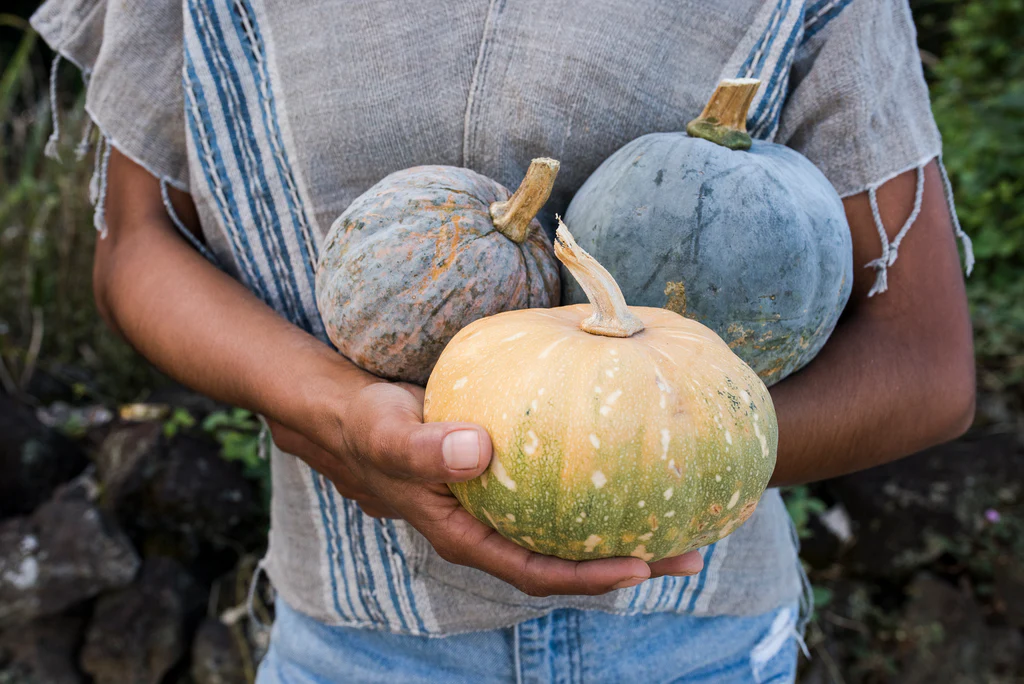
Palaʻai—also known as pumpkin or squash—is one of the oldest known crops. These orange squash fruits have thick skin and full mature seeds, originating in the western hemisphere and grown by Native Americans for thousands of years. Now spread globally, squash is a sustainable favorite, with Hawaiian squash fitting into the Pacific Agroforestry Model, delivering healthy nutrition through delicious squash recipes while supporting the production of other co-crops. Read on to learn how palaʻai fits into different traditional growing models around the world, offering unique sustainable benefits to farmers.
Squash in the Three Sisters Trio
Growing pumpkins, corn and beans alongside each other in the Three Sisters Trio, Native American peoples, ranging from the Hopis of the Southwest to the Oneidas of the Midwest and the Iroquois in the Northeast, hold a spiritual connection with this companion planting, referring to the trio in histories as well as traditional and contemporary recipes. The Three Sisters crops complement each other both nutritionally and agriculturally, with squash playing the crucial role of living mulch in the growing system.
- Pumpkin vines and their broad, prickly leaves shade the ground, reducing evaporation and preserving water in an agricultural system.
- With its rapid green growth, squash acts as a cover crop, suppressing unwanted weeds which may outcompete desired crops.
- By lowering the soil temperature, squash forms a microclimate, preparing the soil for shade-preferring or cool crops.
Squash in the Pacific Agroforestry Model
Brought to Japan in the mid 16th century by Portuguese sailors, pumpkin is thought to have made its way to Hawaiʻi with Japanese immigrants in the plantation era. Kabocha may be the most popular type of pumpkin in Hawaiʻi but squash varieties include butternut, spaghetti, kabocha, acorn, noob tak and more. Throughout the Pacific, squash and pumpkin has been embraced into cuisines and landscapes, nurturing people and the land as a key component of the Pacific Agroforestry Model.
- Squash is used in traditional Pacific Island agroforestry as a cover-crop in the understory, below the tree canopy.
- Pumpkin is very adaptable and can grow in various Pacific environments, from coastal to upland areas.
- The short life cycle of pumpkin makes it suitable for crop rotation, or the practice of rotating where crops are grown in the agroforest to maintain soil fertility.


