
Farmer-led Research
Weed & Ungulate Management for Young ʻUlu Trees
Between May 2023 and July 2025, five farmers from HUC’s network on Hawai‘i Island took part in a hands on trial looking at different ways to manage weeds and protect young ‘ulu trees from pigs. During this sustainable agriculture production, each farmer received materials like mulch, weed mats, fencing, and tires, along with a small stipend to help with regular upkeep.
Over time, every farmer found what worked best for their land. Most preferred mulching with natural materials (palm leaves, grass clippings, or wood chips) rather than using weed mats. When it came to protecting trees from pigs, tires and small fences worked for some, but many farmers agreed that fencing off the entire orchard would be more effective than guarding each tree individually. Based on the outcomes from the management styles and treatments evaluated in this trial, further research into how other factors such as wind and drought affect weed growth and the efficacy of mulch around ‘ulu trees could be beneficial for growers.
From mowing to weedmat, cages to tires, this video explores some of the management methods that Hawaiʻi ʻUlu farmers are using to mitigate the impacts of invasive weeds and pigs when trying to establish new ʻulu tree plantings.
Without Mowing, weeds and grasses often overtake trees, suppress their growth, and can even cause tree mortality. Mowing should be done every 2 to 4 weeks, alone or in combination with other methods such as mulching or weed mat.
The cost of new riding mowers ranges from $1,800 to $5,000, and new trimmers and edgers cost from $90 to $650. It is also important to factor in labor and time, including mower maintenance.
Weed Mat, also known as landscape fabric, is a barrier designed to suppress weed growth by blocking sunlight while still allowing water, nutrients, and air to pass through for tree growth. The cost varies upon tree spacing but typically averages around $50 for a 4’x100’ roll of material, including landscape staples. Labor and time costs should be factored in for each additional application. Weed mats should be reapplied quarterly or as needed when the material has deteriorated and are best used in addition to other methods such as mulching and mowing. Caution should be used when mowing around the weed mat to avoid damage. A disadvantage is that extra care is required during maintenance to prevent tearing, and the material cannot be composted or recycled, making it less environmentally friendly.
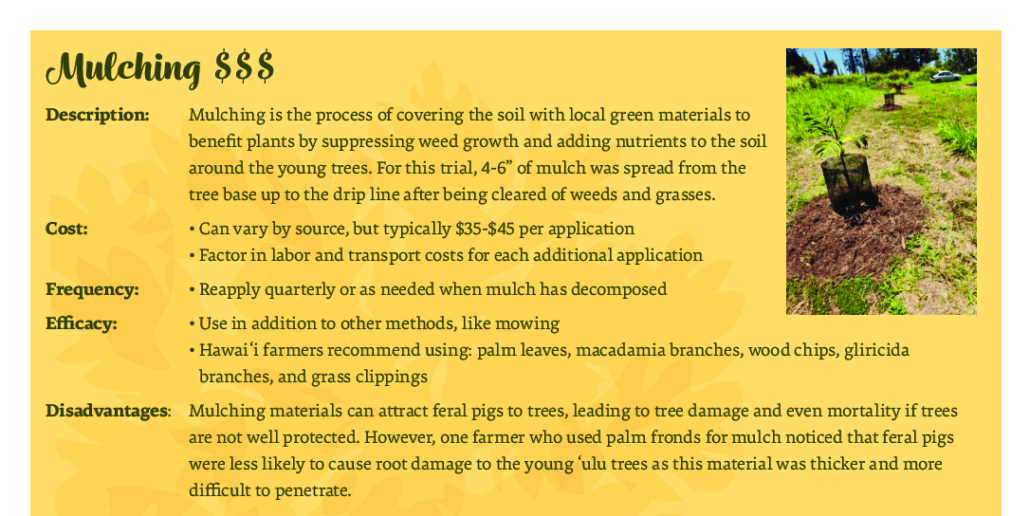
In addition to the advantages and disadvantages of each technique outlined above, other factors may affect the success or failure of young breadfruit plantings. These include microclimate and soil substrate, weather like wind or drought, and the size of the farm.
“Weed mats actually are the most labor intensive, because I have to keep the grass from intruding across it with a weed whacker. I can’t use the mower because it can get stuck…my blade caught the plastic and that was a nightmare. I’d have to weed-whack every two weeks, and I just couldn’t keep up.”
Tire barriers consist of stacking three tires vertically around each tree, with holes drilled or punctured to prevent water retention. This method is typically a great way to reuse old or spare tires, though costs can vary. Tire barriers should be installed at the time of tree planting and used in addition to other methods, such as tree cages, while mowing regularly around the barrier and considering fencing around the entire orchard. However, as trees grow, removing the tires can become costly and time-intensive, and the tires may collect debris or water that will need to be cleared out periodically.
Building wire cages around newly planted trees protects them from ungulate damage. These cages are roughly 3 feet wide and 4 feet tall and are attached by crimping the wire together around the tree. In some cases, weed mat is added around the sides of the cage to provide a visual barrier from pigs. Each cage costs about $40 per application, with additional labor and time costs for installation around each tree. Cages should be installed at the time of tree planting and adjusted as the tree grows. They are most effective when used in addition to other interventions such as mulch or tires and can help keep ungulates away from the tree, though regular upkeep will be required. It may also be beneficial to install fencing around the orchard. However, pigs may still push through cages and cause damage, and the cages can make it difficult to remove weeds growing inside.
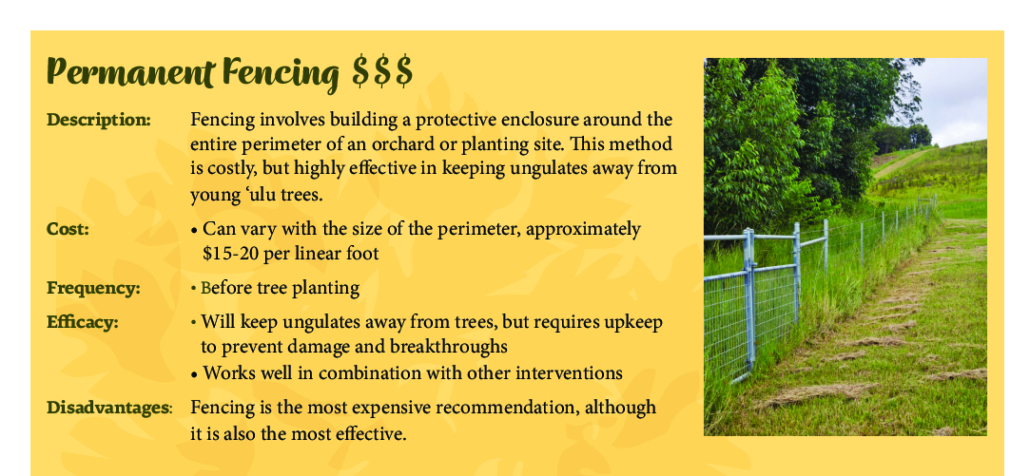
For farmers on islands with Axis Deer or similar tall ungulate pests, 6-foot-tall wire cages around trees or 8-foot-tall perimeter fencing may be required. Although it wasnʻt a part of this trial, some farmers also incorporate trapping as part of their management strategy, using cage-style traps for individual animals and corral-style traps for capturing entire herds. Traps, trap rentals, and trapping services can often be found online.
“I like the mulch, but the pigs…they scattered the mulch all over. If you can afford it, number one – fence your fields in terms of stopping the pig damage.”
To hear more about these issues directly from our farmers, check out the recording below of an in-person panel discussion focusing on this project and the farmerʻs experiences with these issues.



